
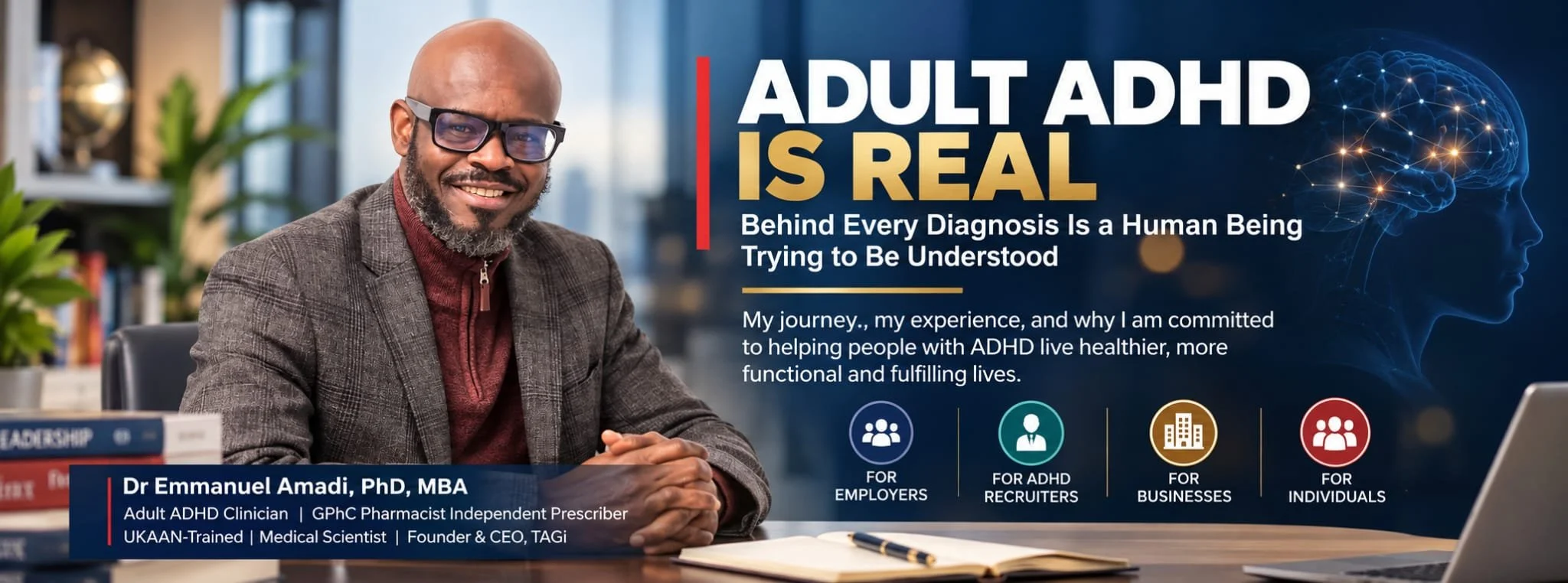
ADULT ADHD IS REAL
"You are intelligent. You are successful. So how can you possibly have ADHD?"
That question reveals how easily we misunderstand a condition that has been investigated by researchers around the world for decades.
ADULT ADHD IS REAL: The Science Is Clear. Why Are We Still Questioning People's Experiences?
Behind every diagnosis is a human being trying to be understood.
By Dr Emmanuel Eni Amadi, PhD, Executive MBA
Adult ADHD Clinician | GPhC Pharmacist Independent Prescriber | UKAAN-Trained | Medical Scientist
10 October 2026.
"You seem perfectly normal.
How can you possibly have ADHD?"
Imagine spending years trying to keep your life together.
You work hard. You meet deadlines, although sometimes at enormous personal cost. You appear organised, confident and capable.
But behind that appearance, you struggle with concentration, forgetfulness, emotional regulation, procrastination or a mind that rarely seems to switch off.
Then someone tells you:
"Everyone gets distracted. Stop making excuses."
For some adults living with ADHD, those words can be as painful as the symptoms themselves.
I decided to write this article this weekend after reviewing a patient’s ADHD medication and titration dose of methylphenidate 40 mg MR capsules - one daily with breakfast- with terrible side effects: mood changes, loss of appetite, insomnia, and all that not, to the current dose below, until functional impairments were stabilised with the following adjustments:
Days 1-18 of menstrual cycle: 20 mg MR caps (Meflynate) once daily with breakfast x 18 capsules.
Days 19-28 of the menstrual cycle: 30 mg MR caps once daily with breakfast x 10 capsules.
In addition, I came across an article by Emma Gritt - the Associate Health Editor of the Daily Mail- published on 9 October 2026, titled “ADHD Is Real. I've Spent a Lifetime Battling the Symptoms. I'm Sick of People Saying I'm Faking It.”
Her account struck me because it illustrates a problem extending far beyond ADHD: our tendency to judge people's capabilities without understanding the difficulties they may be experiencing.
An employer questioned her ADHD diagnosis because she appeared organised and enthusiastic about work.
Yet outward competence can conceal substantial internal effort.
Being successful does not mean someone cannot have ADHD. Being articulate does not mean someone cannot struggle. And being professionally accomplished does not invalidate a clinical diagnosis.
What Does the Science Actually Say?
As a PhD-qualified medical scientist, I believe discussions about ADHD must be grounded in evidence rather than assumptions.
In 2021, Professor Stephen V. Faraone and an international group of researchers published the World Federation of ADHD International Consensus Statement.
The researchers, representing 27 countries, identified 208 evidence-based conclusions about ADHD.
Their work examined the disorder's clinical characteristics, developmental course, associated risks and treatment evidence.
This is not a condition invented by social media.
It is supported by decades of psychiatric, psychological, genetic and neuroscientific research.
Professor Henrik Larsson of Örebro University and Karolinska Institutet, working with Professor Faraone, also reviewed the genetics of ADHD in Molecular Psychiatry.
Their findings described substantial genetic contributions, with heritability estimates of approximately 74%.
That does not mean 74% of an individual's ADHD is caused by genes. Heritability describes variation within a studied population.
Another major investigation, led by Dr Martine Hoogman and colleagues in the international ENIGMA ADHD Working Group, examined brain imaging from more than 3,200 participants.
The researchers identified small average differences in several brain structures, particularly among children.
These findings support biological research into ADHD, although brain scans cannot diagnose ADHD in individual patients.
The science is compelling. But good science also requires us to acknowledge what we do not yet know.
A 2025 review led by Professor Samuele Cortese in World Psychiatry reinforces the validity of Adult ADHD while examining unresolved questions about diagnosis, impairment and treatment.
That is how credible medicine advances: through evidence, scrutiny and continuous learning.
Why ADHD Matters to Me After 26 Years in Healthcare
My journey into Adult ADHD care is not a sudden change of profession.
It is an extension of a career spent working with people, medicines, healthcare systems and scientific research.
Over more than 26 years, my professional experience has included community pharmacy, GP surgeries and NHS primary care, digital pharmacy, pharmaceutical wholesale and executive healthcare leadership.
I previously founded and led an NHS-contracted distance-selling pharmacy and pharmaceutical wholesale organisation, growing it into a substantial business employing more than 50 people.
I also hold a PhD in Medical Sciences from the University of Bradford, where my research investigated graphene oxide nanoparticles, genetic toxicity and DNA damage in human blood samples from patients with pulmonary diseases.
My scientific work taught me an important lesson:
Never dismiss something simply because you cannot immediately see it. Investigate it. Understand it. Follow the evidence.
That philosophy influences my growing interest in Adult ADHD.
During my Independent Prescribing development, I participated in supervised clinical practice across five GP surgeries, involving approximately 155–200 patients.
My clinical exposure included ADHD screening and medication monitoring, mental health and antipsychotic medication reviews, GLP-1 weight-management pathways and medicines optimisation.
I subsequently completed UKAAN specialist training in Adult ADHD Assessment & Diagnosis and Pharmacological Treatment, following extended shadowing of ADHD prescribers.
I am now seeking to deepen my clinical experience within specialist, multidisciplinary ADHD services.
Why?
Because I want to contribute to helping people move beyond merely coping with symptoms towards better everyday functioning, greater independence and improved quality of life.
To Employers: ADHD Is Not a Measure of Intelligence
A person with ADHD may be highly educated, creative, articulate and professionally accomplished.
Yet that same individual may struggle with task initiation, organisation, time management or maintaining attention.
Researchers Kirsty Lauder and Professor Almuth McDowall of Birkbeck, University of London, together with Professor Harriet Tenenbaum of the University of Surrey, examined interventions intended to support adults with ADHD in the workplace.
Their 2022 systematic review identified important gaps in workplace-specific evidence and highlighted the need for better support mechanisms.
For employers, this raises an important question:
Are we evaluating someone's contribution fairly, or are we confusing a difficulty with organisation or attention for a lack of ability?
Reasonable workplace adjustments, clear communication, appropriate task structures and an informed management culture may help.
Not every employee who struggles has ADHD. Not every person with ADHD needs identical adjustments.
But dismissing someone before understanding their circumstances is poor people management.
Why Adult ADHD Prescribing Matters
For appropriately diagnosed adults, medication can be an effective component of treatment.
Professor Samuele Cortese and colleagues examined 133 randomised trials in a major 2018 Lancet Psychiatry network meta-analysis.
Their findings demonstrated short-term benefits of several ADHD medicines, alongside differences in tolerability and important gaps in longer-term evidence.
In UK practice, NICE guideline NG87 recommends evidence-based assessment, individualised treatment and ongoing monitoring.
As a Pharmacist Independent Prescriber, I recognise that safe ADHD prescribing requires more than pharmacological knowledge.
It requires careful clinical assessment, appropriate prescribing competence, cardiovascular and mental health risk evaluation, titration, adverse-effect monitoring and shared decision-making.
A prescription is not the destination. Improved patient functioning is the objective.
Medication is not appropriate or desired for every patient. Environmental modifications, psychoeducation and psychological support also have important roles.
A Message to ADHD Recruiters and Digital Healthcare Providers
The growing demand for Adult ADHD services creates opportunities, but also responsibilities.
Healthcare organisations need clinicians who understand assessment pathways, prescribing governance, medicines optimisation, multidisciplinary collaboration and patient safety.
Digital healthcare can improve access, but clinical quality must remain central.
My professional experience combines clinical pharmacy, regulated digital healthcare, executive leadership and biomedical research.
I believe that combination can contribute meaningfully to the development of safe, accessible and sustainable ADHD services.
Beyond the Clinic
When I am not engaged in clinical practice, I work through The Amadi Global Institute (TAGi), Glasgow, supporting professionals and organisations with leadership development, executive education and strategic career progression.
I also host The Dr Amadi Show, exploring leadership, human behaviour, resilience and professional development.
My books, including Emotional Rulership, Chunky Habits and Corporate Warriors, reflect my longstanding interest in how people think, behave, develop and overcome challenges.
My interest in ADHD is therefore both clinical and deeply connected to my wider professional philosophy.
People should not be defined solely by the difficulties they experience.
My Final Thought
To the adult who has spent years being misunderstood: your experiences deserve to be taken seriously.
To employers: do not confuse ADHD-related difficulties with a lack of intelligence or ambition.
To recruiters and healthcare organisations: prioritise clinical competence, appropriate supervision, patient safety and compassionate care.
And to fellow clinicians: let us continue learning, questioning and practising evidence-based medicine.
After 26 years in healthcare, my motivation remains simple.
I want to help people live healthier, more functional and more fulfilling lives.
ADHD is real.
The science matters.
But so does the person behind the diagnosis.
Dr Emmanuel Eni Amadi, PhD, Executive MBA
Adult ADHD Clinician | GPhC Pharmacist Independent Prescriber | UKAAN-Trained
Medical Scientist & Nanotoxicologist
Founder & CEO, The Amadi Global Institute, Glasgow, UK
Website: https://www.amadiglobal.com/
I welcome connections with Adult ADHD clinical directors, NHS primary care organisations, specialist recruiters, digital healthcare providers and multidisciplinary services.
#AdultADHD #ADHDAwareness #ADHDPrescribing #UKAAN #IndependentPrescriber #PrimaryCare #MentalHealth #DigitalHealth #Neurodiversity #HealthcareLeadership
references
1. Faraone, S. V., et al. (2021)
The World Federation of ADHD International Consensus Statement: 208 Evidence-based Conclusions about the Disorder.
Neuroscience & Biobehavioral Reviews, 128, 789–818.
PubMed
2. Faraone, S. V., & Larsson, H. (2019)
Genetics of Attention Deficit Hyperactivity Disorder.
Molecular Psychiatry, 24, 562–575.
SUNY Upstate Medical University, Örebro University and Karolinska Institutet.
Molecular Psychiatry
3. Hoogman, M., et al. (2017)
Subcortical Brain Volume Differences in Participants with ADHD in Children and Adults: A Cross-sectional Mega-analysis.
The Lancet Psychiatry, 4(4), 310–319.
ENIGMA ADHD Working Group, including researchers affiliated with Radboud University Medical Center.
PubMed
4. Cortese, S., et al. (2018)
Comparative Efficacy and Tolerability of Medications for ADHD in Children, Adolescents, and Adults: A Systematic Review and Network Meta-analysis.
The Lancet Psychiatry, 5(9), 727–738.
The Lancet Psychiatry
5. Lauder, K., McDowall, A., & Tenenbaum, H. R. (2022)
A Systematic Review of Interventions to Support Adults with ADHD at Work.
Frontiers in Psychology.
Birkbeck, University of London, and University of Surrey.
PubMed
6. National Institute for Health and Care Excellence (NICE)
Attention Deficit Hyperactivity Disorder: Diagnosis and Management (NG87).