

ADHD, Depression or Bipolar?
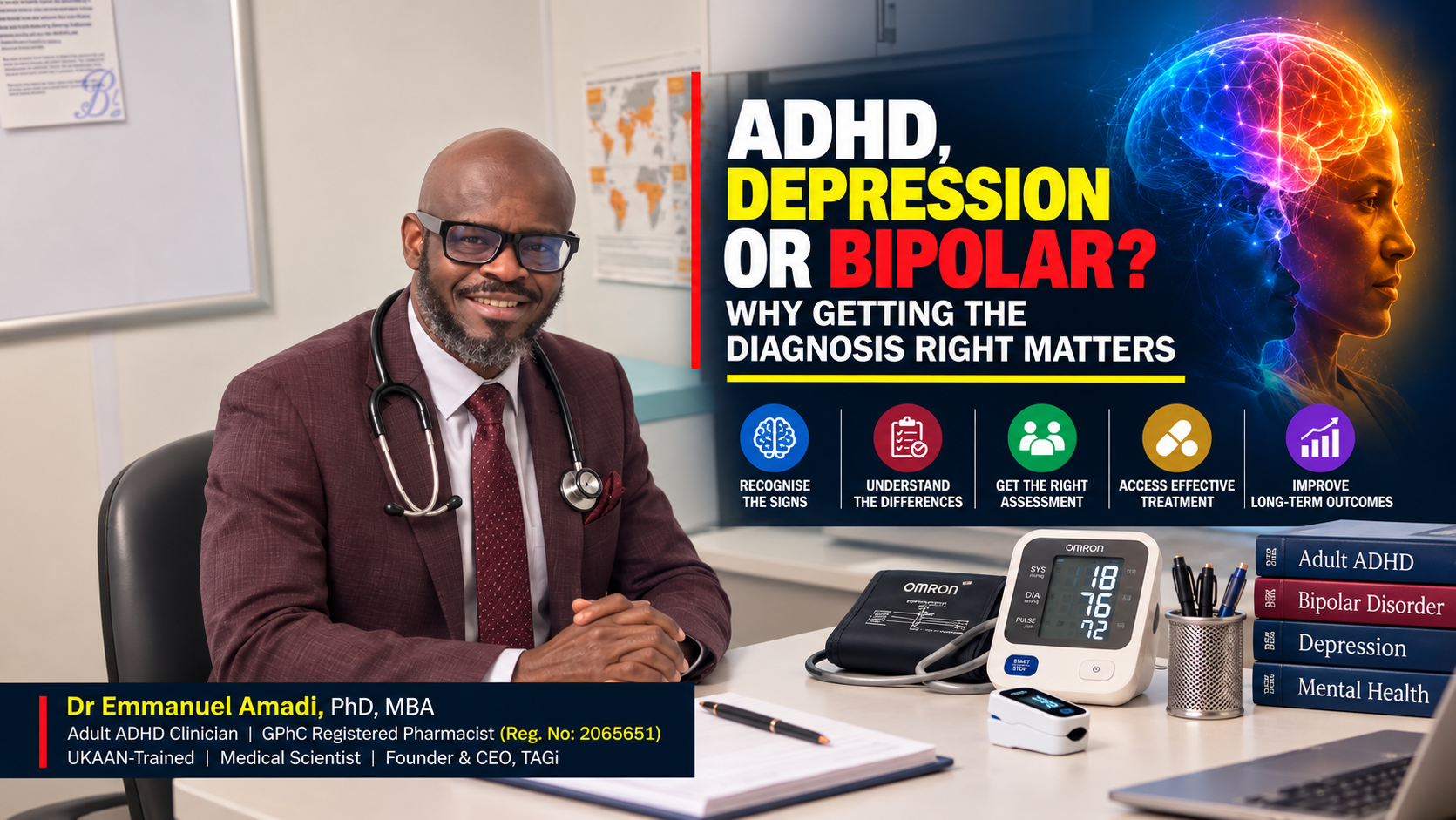
ADHD, Depression or Bipolar?:
Why Getting the Diagnosis Right Matters
Why some people spend years being treated for depression before bipolar disorder or ADHD, is recognised — and what this means for NHS primary care, antidepressant prescribing and adult ADHD assessment.
By Dr Emmanuel Eni Amadi, PhD, Executive MBA
GPhC-Registered Pharmacist Independent Prescriber | UKAAN-Trained Adult ADHD Clinician | Medical Scientist | Founder & CEO, The Amadi Global Institute
Wed, 14 October, 2026
Fourteen Years of Depression. Then a Different Diagnosis.
To really grasp this article, I would ask you for a small favour. Sit down on your sofa in the lounge or in your kitchen. Have a cup of tea or coffee. If possible, read this without distraction - when you have the house for yourself. That’s exactly what I did this Sunday afternoon, 11th October 2026, while going through the draft before publishing it on 14th October. My wife was at work. Our teenage boys were upstairs in their bedrooms, hooked up “dopaminergically” to their phones, so I had the entire downstairs to myself- the kitchen and my office, all on my own. WOW! Sorry, I made up this verb “dopaminergically”. Apologies to the Oxford Dictionary, just in case you can’t find it listed.
So, let’s begin!
Imagine being treated for depression for 14 years, not 14 months or 14 days.
You attend appointments, take prescribed antidepressants and hope that, eventually, you will feel better. Does this sound familiar?
But your mental health remains unpredictable. Some months you cannot get out of bed. At other times, you have extraordinary energy like Spider-Man, sleep very little (insomnia), speak rapidly, and feel capable of doing almost anything. This sounds like a movie, right?
You assume these are simply good days and bad days.
Then your behaviour changes dramatically. Your family becomes frightened. You are admitted to a psychiatric hospital against your wishes.
Only then does a different diagnosis emerge.
Bipolar disorder.
This was the experience of Kimberley Atkinson, whose story BBC Scotland Health Producer Georgina Hayes reported on 11 October 2026.
In the BBC report, Kimberley described depressive episodes that felt like "sinking into a dark hole". Later, she experienced severely disturbed thinking and behaviour, eventually requiring hospital admission (Hayes, 2026).
Another woman featured in the report, Jacqui Armstrong, spent more than 30 years receiving treatment for depression before being diagnosed with bipolar II disorder.
These stories raise a difficult question:
How many people are receiving treatment for the symptoms clinicians can see, while the underlying pattern of illness remains unidentified?
What Exactly Is Bipolar Disorder?
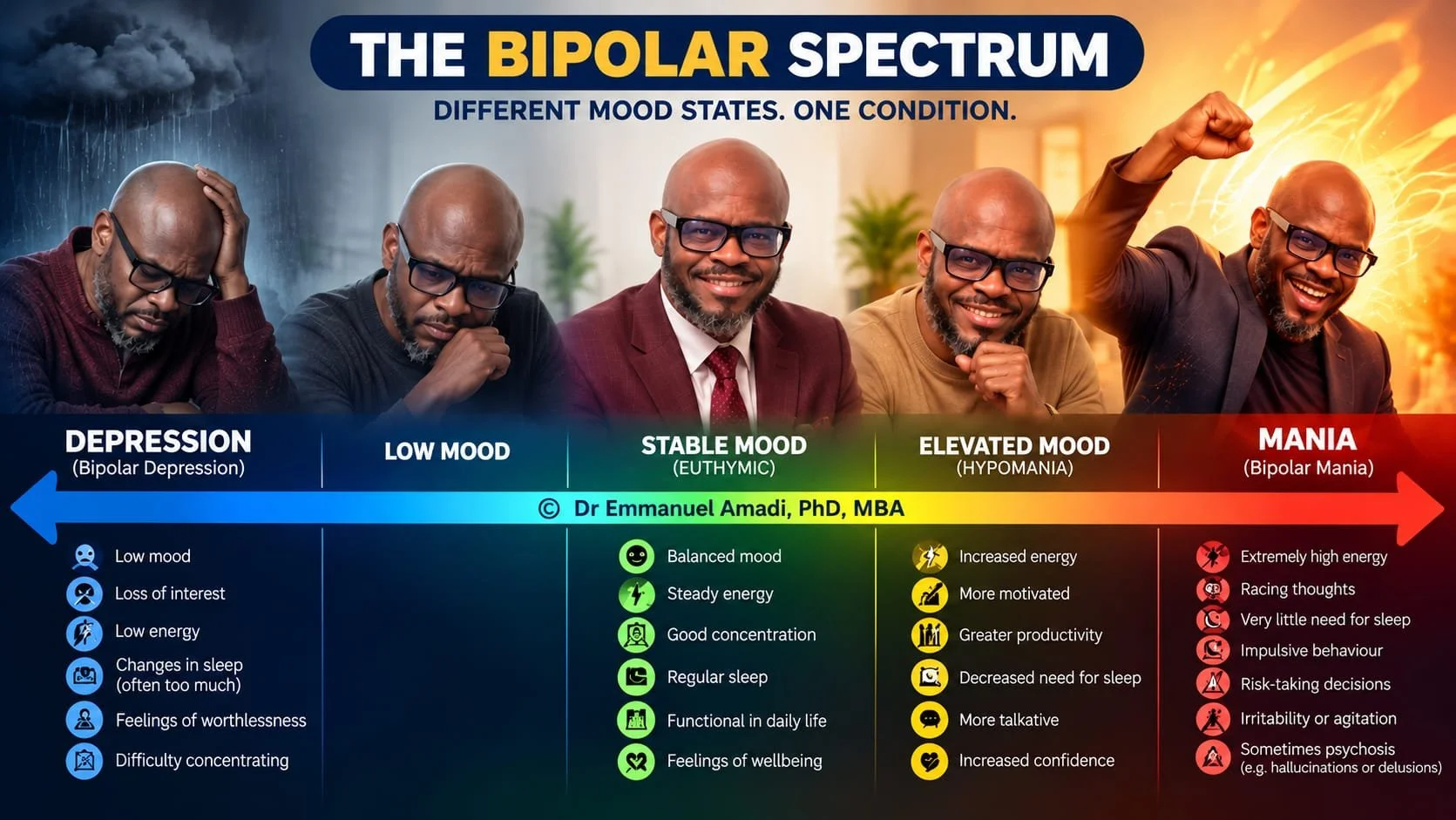
The Bipolar Spectrum | Dr Emmanuel Eni Amadi in different mood states - One condition - several spectrum | Amadi Global Institute - 14 October 2026
Bipolar disorder is a mental health condition characterised by episodes of significant changes in mood, energy, activity and functioning.
The word bipolar refers to the contrasting mood states that can occur at each end of the spectrum: depression at one end and mania or hypomania at the other.
But bipolar disorder is not simply ordinary moodiness.
We all experience emotional highs and lows. We may feel enthusiastic after receiving good news or discouraged after a difficult week.
Bipolar episodes are different. They represent sustained changes from a person's usual behaviour and can seriously affect relationships, judgement, employment, finances and personal safety.
According to NICE (2014, updated subsequently), diagnosing bipolar disorder requires a detailed psychiatric history, including previous episodes of elevated mood, changes in behaviour, family history, treatment response and functional impairment.
There are two principal diagnostic forms.
Bipolar I disorder involves at least one manic episode. Depression is common but is not required for a DSM-5 bipolar I diagnosis.
Bipolar II disorder involves at least one hypomanic episode and at least one major depressive episode, without any history of full mania.
This distinction matters because hypomania is often less obvious than mania.
Mania, Hypomania and Depression: What Do They Look Like in Everyday Life?
These conditions wear different clothes, depending on the high streets you find them. That someone is nice to you today, well dressed, and professionally presentable does not mean that they are not suffering internally, emotionally, and psychologically.
Consider someone who normally sleeps seven hours each night.
Suddenly, they begin sleeping only two or three hours yet feel unusually energetic.
They start several ambitious projects, speak faster than usual and become convinced they have discovered an extraordinary business opportunity.
They may spend money recklessly, make impulsive decisions, become unusually irritable or behave in ways completely unlike their normal personality.
In severe mania, someone may develop delusions, lose touch with reality or require hospital treatment.
Mania is not simply being happy, ambitious or energetic. It is a clinically significant change in mood and functioning.
Hypomania shares several features with mania but is less severe. The person may become unusually productive, sociable, confident or energetic without recognising anything is wrong.
For some, hypomania initially feels pleasant.
The problem is that it can be followed by depression.
During depression, the same person may experience overwhelming fatigue, hopelessness, poor concentration, withdrawal from family, disrupted sleep and loss of interest in activities they previously enjoyed.
This creates a diagnostic challenge: people frequently seek help during depression, not when they feel unusually energetic.
Why Is Bipolar Disorder So Often Diagnosed as Depression?
The evidence from the UK is concerning.
The Bipolar Commission reported an average delay of 9.5 years between first seeking professional help and receiving a bipolar diagnosis (Bipolar UK, 2022).
In its survey of 2,458 people with bipolar disorder, nearly 70% reported previously receiving a depression diagnosis (National Centre for Mental Health, 2021).
The same Commission found that diagnostic delays were particularly prolonged for bipolar II disorder, averaging 11.1 years compared with 8.2 years for bipolar I.
These are survey findings rather than a direct measure of the performance of every GP practice.
Nevertheless, they reveal a substantial problem.
In a 2025 qualitative study, Hoppe and colleagues examined why bipolar diagnosis is delayed, drawing on the perspectives of GPs and psychiatrists.
The research included Professor Andrea Cipriani of the University of Oxford and Professor Carolyn Chew-Graham of Keele University.
The researchers identified difficulties recognising bipolar symptoms in primary care, limited opportunities to obtain detailed histories, and challenges within referral and specialist assessment pathways (Hoppe et al., 2025).
The explanation is not necessarily that GPs are careless.
Depression is much more common than bipolar disorder, appointments are short, and people experiencing hypomania may not consider their elevated mood a medical problem.
Professor Daniel Smith, Chair of Psychiatry at the University of Edinburgh, told the BBC that GPs are often focused on recognising depression because that is how patients initially present (Hayes, 2026).
The lesson is clear:
When someone repeatedly presents with depression, clinicians should consider whether there is a history of mania or hypomania that has not yet been recognised.
The NHS Waiting-Time Problem
Delayed diagnosis is not identical to waiting on an NHS appointment list.
A person may receive healthcare for years without bipolar disorder being recognised. Another may have suspected bipolar disorder but face delays accessing specialist psychiatric assessment.
Both situations can prolong suffering.
In March 2024, Bipolar UK and the Royal College of Psychiatrists jointly called for the average diagnostic delay to fall from 9.5 years to five years, alongside improved specialist care pathways.
The organisations highlighted the importance of early assessment, continuity of care and access to appropriately trained professionals (Bipolar UK and Royal College of Psychiatrists, 2024).
A major difficulty is that there is no single comprehensive, routinely published UK-wide waiting-time measure specifically for bipolar diagnostic assessments.
This makes it difficult to quantify precisely how much of the diagnostic delay is attributable to waiting lists, missed recognition, referral barriers or other factors.
However, the evidence is sufficient to establish that, like ADHD assessment/Diagnosis, delays are substantial, and that improved recognition and specialist access are necessary.
The Medication Question: Can Antidepressants Make Bipolar Disorder Worse?
This is one of the most important clinical issues.
Antidepressants can be appropriate for major depressive disorder. They also have selected roles in treating bipolar depression when prescribed within an appropriate treatment plan.
But antidepressant monotherapy may be unsuitable for some people with bipolar disorder because of concerns about switching into mania or hypomania and mood destabilisation.
The risks vary according to the patient, medicine, clinical history and treatment context.
NICE guideline CG185 recommends reviewing antidepressant treatment if mania or hypomania develops, and considering appropriate antipsychotic treatment.
For bipolar depression, NICE identifies options including quetiapine, fluoxetine combined with olanzapine, and lamotrigine in specified circumstances.
Lithium remains a major option for long-term relapse prevention.
Professor Michael Bauer and colleagues at Technische Universität Dresden, Germany, have contributed extensively to evidence-based bipolar treatment guidelines, emphasising early diagnosis, individualised treatment and long-term management (Pfennig et al., 2013).
The central clinical principle is not that antidepressants are inherently wrong.
It is that treatment must match the patient's diagnosis, history, risks and current clinical presentation.
A missed diagnosis may expose someone to ineffective or unsuitable treatment. But a delayed diagnosis does not, by itself, prove medical negligence.
That judgement requires careful examination of the clinical records, the information available to each clinician and the standard of care at the time.
Patients concerned about their medication should seek a professional review rather than stopping treatment abruptly.
When ADHD meets Bipolar Disorder
My growing clinical interest in Adult ADHD makes this subject particularly relevant.
ADHD and bipolar disorder are distinct conditions, but some symptoms overlap.
Both may involve distractibility, restlessness, impulsivity, rapid speech and difficulty regulating emotions.
The key difference is often the pattern over time.
ADHD is a neurodevelopmental condition, with symptoms beginning during childhood and generally following a persistent pattern.
Bipolar disorder is characterised by distinct mood episodes that represent changes from a person's usual state.
For example, someone with ADHD may have struggled with organisation, distractibility and impulsivity since childhood.
Someone experiencing mania may suddenly become unusually talkative, require very little sleep and engage in uncharacteristically risky behaviour for several days or longer.
A person can also have both conditions.
A major systematic review and meta-analysis involving 71 studies and 646,766 participants found that approximately 7.95% of adults with ADHD also had bipolar disorder, while 17.11% of adults with bipolar disorder also had ADHD (2021).
The researchers stressed that the overlap requires careful diagnostic assessment.
For clinicians, this means taking a developmental history, examining mood episodes and assessing whether symptoms are persistent, episodic or both.
It also means considering sleep disorders, substance use, anxiety, trauma, medication effects and other possible explanations.
The correct diagnosis is not always ADHD or bipolar. Sometimes it is ADHD and bipolar. Sometimes it is neither.
This is why structured assessment and clinical judgement matter more than relying on a questionnaire alone.
Living With Bipolar Disorder: Successful People Are Not Exempt
Bipolar disorder does not discriminate according to wealth, education, talent or professional achievement.
Several public figures have openly discussed living with the condition.
British broadcaster and actor Stephen Fry has spoken publicly about bipolar disorder and contributed to greater awareness through his documentary work.
Welsh actor Catherine Zeta-Jones has publicly discussed bipolar II disorder.
American singer Mariah Carey disclosed her bipolar II diagnosis in 2018, describing the difficulty of living with stigma before seeking treatment.
Singer Selena Gomez has also publicly discussed receiving a bipolar diagnosis.
American musician Chappell Roan has spoken about her experience of bipolar II disorder.
These disclosures matter because they challenge the misconception that a person with bipolar disorder cannot sustain a successful career.
However, celebrity experiences should not be treated as clinical evidence. They demonstrate lived experience and help reduce stigma; scientific conclusions must still come from systematic research.
Treatment Is More Than Medication
Although pharmacological treatment is central to many bipolar care plans, medication alone is not the complete answer.
Effective long-term management may include psychoeducation, cognitive behavioural therapy, family-focused interventions, regular sleep patterns, relapse-prevention planning, psychological support and careful monitoring of early warning signs.
Research by Professor David Miklowitz and colleagues has shown that structured psychosocial interventions, when combined with appropriate medication, can improve important outcomes for people living with bipolar disorder.
Patients and families can benefit from learning to recognise changes in sleep, activity, mood and behaviour that may precede relapse.
For some people, maintaining consistent sleep and daily routines is particularly important.
Treatment should also address physical health, medication adverse effects, relationships, employment and quality of life.
The aim is not merely to suppress symptoms.
It is to help people remain well, maintain relationships, work where possible and live fulfilling lives.
From Emotional Rulership to Mental Health Clinical Practice: My Personal Journey
My interest in mental health did not begin with my Adult ADHD training with UKAAN - London.
In 2019, I attended executive education at Harvard University Extension School, developing my understanding of strategic leadership and the role of emotional intelligence in professional and personal effectiveness.
That experience influenced my subsequent writing, including my book Emotional Rulership.
The book reflects my longstanding interest in emotional awareness, self-management, human behaviour and leadership.
Today, as a PhD-qualified medical scientist, GPhC-registered Pharmacist Independent Prescriber and UKAAN-trained Adult ADHD clinician, that interest has developed into a more focused clinical commitment.
I have spent more than 26 years working across pharmacy - hospital, primary care (GP practices), digital healthcare, pharmaceutical wholesale and healthcare leadership.
During my supervised prescribing development, I gained experience in mental health medication reviews, antipsychotic monitoring, ADHD screening and medicines optimisation.
My professional journey has therefore brought together three areas that I believe should never be separated:
Scientific evidence,
Emotional understanding, and
Clinical responsibility.
But an important distinction must be made.
Emotional intelligence is not a substitute for psychiatric diagnosis or treatment. Bipolar disorder cannot be resolved simply through positive thinking, motivation or stronger emotional discipline.
My interest in emotional intelligence helps shape how I communicate, listen and approach patients. Evidence-based clinical care must determine how mental health conditions are assessed and treated.
My Message to Clinicians, NHS Leaders and Patients
The BBC stories of Kimberley Atkinson and Jacqui Armstrong are reminders that a diagnosis can shape years of someone's life.
To patients experiencing recurrent depression, particularly alongside periods of unusually elevated mood or reduced need for sleep: discuss the full pattern of symptoms with an appropriately qualified healthcare professional.
To clinicians: consider the whole history, not only the symptoms presented during one appointment.
To healthcare leaders: strengthen referral pathways, continuity of care and access to specialist psychiatric assessment.
To employers and families: understand that bipolar disorder is a treatable medical condition, not a character defect.
And to those living with bipolar disorder:
“Your diagnosis does not define your intelligence, your ambition or your worth.”
After more than 26 years in healthcare, I remain convinced that the purpose of medicine is not simply to prescribe treatment.
It is to understand the person, establish the most accurate diagnosis possible and support better long-term outcomes.
Fourteen years is a long time to wait for an explanation. Thirty years is longer still.
We must work towards a healthcare system where fewer people have to wait that long.
Dr Emmanuel Eni Amadi, PhD, Executive MBA
GPhC-Registered Pharmacist Independent Prescriber
UKAAN-Trained Adult ADHD Clinician | Medical Scientist
Founder & CEO, The Amadi Global Institute (TAGi), Glasgow
This article is intended for public education and professional discussion. It does not provide an individual diagnosis or replace specialist psychiatric assessment.
reference
1. Hayes, G. (2026) ‘I was told I had depression for 14 years until I got sectioned – it was bipolar’, BBC News, 11 October. Available at: BBC article.
2. Bipolar UK (2022) Bipolar Minds Matter: Bipolar Commission Report. Available at: Bipolar Commission report.
3. National Centre for Mental Health (2021) ‘Bipolar UK report: 56% of people with bipolar disorder in the UK are undiagnosed’. Cardiff University. Read report.
4. Hoppe, I. et al. (2025) ‘Reducing the Delay in the Diagnosis of Bipolar Disorder: A Qualitative Study’, Health Expectations, 28(4), e70398. Read study.
5. National Institute for Health and Care Excellence (NICE) (2014, subsequently updated) Bipolar disorder: assessment and management. Clinical guideline CG185. Read NICE guideline.
6. Bipolar UK and Royal College of Psychiatrists (2024) ‘Joint Statement’, 30 March. Read statement.
7. Pfennig, A., Bschor, T., Falkai, P. and Bauer, M. (2013) ‘The Diagnosis and Treatment of Bipolar Disorder: Recommendations From the Current S3 Guideline’, Deutsches Ärzteblatt International, 110(6), pp. 92–100. Read study.
8. Comorbidity of ADHD and adult bipolar disorder: A systematic review and meta-analysis (2021), Neuroscience & Biobehavioral Reviews. Read study.
9. Miklowitz, D.J. et al. (2007) ‘Intensive psychosocial intervention enhances functioning in patients with bipolar depression: Results from a 9-month randomized controlled trial’, American Journal of Psychiatry. Read publication.
10. NHS England (2025) Adult Psychiatric Morbidity Survey 2023/24: Chapter 11 — Bipolar Disorder. Read NHS survey.