

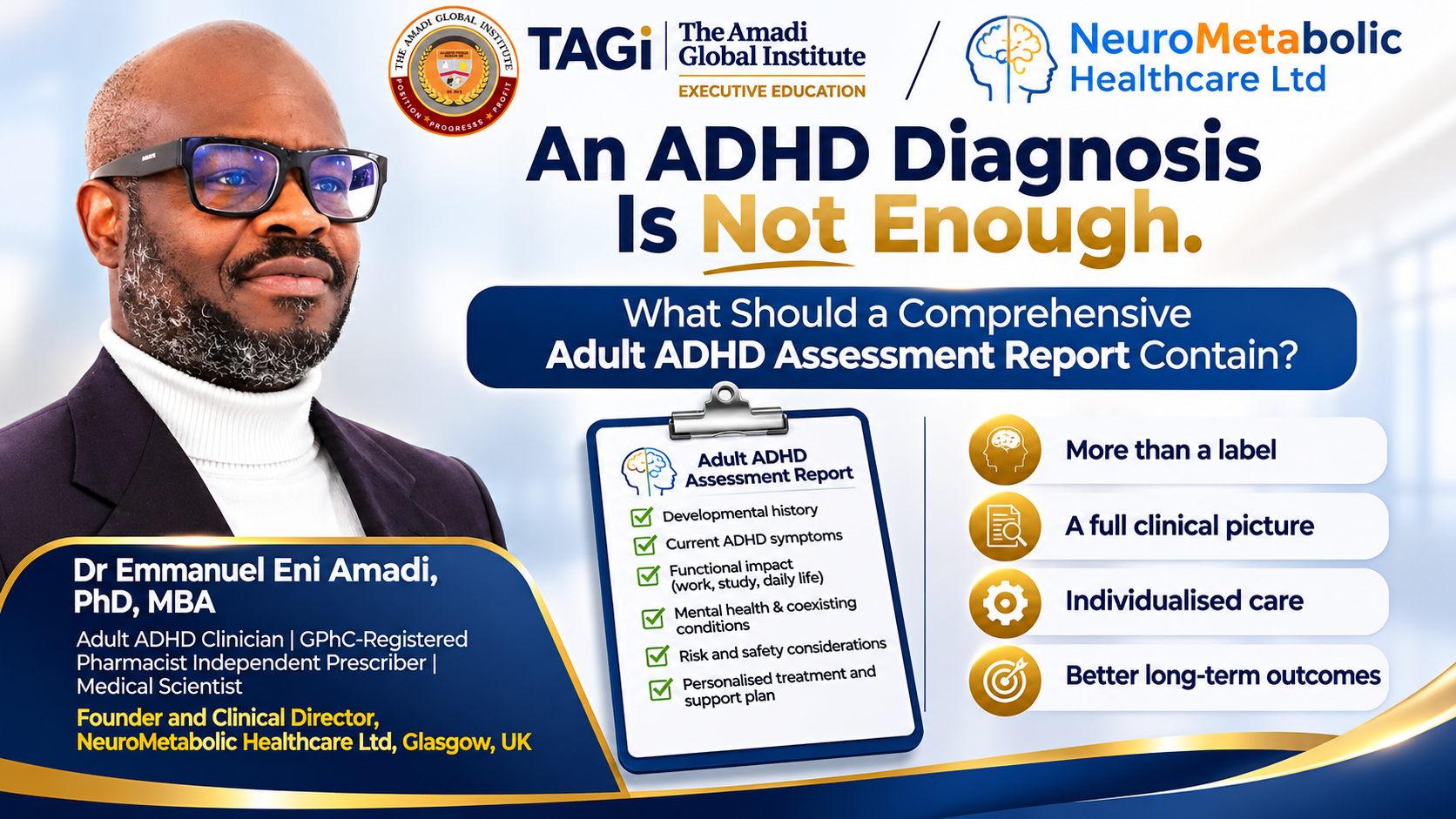
Why the quality of the clinical report matters as much as the diagnostic conclusion
By Dr. Emmanuel Eni Amadi, PhD, MBA
ADHD Clinical Evidence Series | Instalment 3 | 1 November 2026
Introduction:
When the Assessment Ends, the Evidence Should Remain
Imagine waiting several months, perhaps longer, for an Adult ADHD assessment.
You attend your appointment, discuss your childhood, explain your difficulties at work and describe how your symptoms affect your relationships and everyday life.
At the end, the clinician tells you that you meet the diagnostic criteria for ADHD.
A few days later, you receive a report.
It contains your name, the date of assessment and a short statement confirming ADHD.
But there is little explanation of your symptoms, developmental history, functional impairment or the clinical reasoning behind the diagnosis.
Would that be sufficient?
Not necessarily.
A diagnosis may be correct, but a poorly documented assessment can make it difficult for another clinician to understand how that conclusion was reached.
This distinction is particularly important when patients move between healthcare providers, request further treatment or require ongoing specialist review.
The purpose of a comprehensive ADHD assessment report is therefore not simply to record a diagnostic label.
It is to demonstrate how the available clinical evidence supports—or does not support—the diagnosis.
In 2024, Adamou and colleagues published the Adult ADHD Assessment Quality Assurance Standard (AQAS), providing a detailed framework for improving the quality and consistency of adult ADHD assessments and reports.
The authors identified an important problem: insufficiently documented assessments may lead to uncertainty, repeated evaluations and delays in treatment (Adamou et al., 2024).
A well-prepared report should reduce avoidable uncertainty while supporting appropriate continuity of care.
1. Why Is an Adult ADHD Assessment Report Important?
A comprehensive assessment report serves several purposes.
For the patient, it provides an explanation of the difficulties explored during assessment and the clinical conclusion reached.
For the assessing clinician, it records the evidence, reasoning and professional judgement underpinning that conclusion.
For other healthcare professionals, it provides information that may be needed to plan treatment, evaluate risk or continue care.
For healthcare organisations, it contributes to clinical governance, accountability and the quality of patient records.
However, the value of the report depends on its content.
A report containing numerous pages of generic ADHD information is not necessarily better than a shorter document that clearly explains the patient's individual presentation.
The AQAS specifically emphasises that report length alone should not be used as a measure of quality.
What matters is whether the report contains sufficient relevant evidence to support its conclusions (Adamou et al., 2024).
This is a principle I consider fundamental to evidence-based clinical practice.
A clinical conclusion should be understandable, traceable and defensible.
2. What Does NICE NG87 Require?
NICE guideline NG87 establishes the clinical requirements for ADHD diagnosis and management.
Recommendation 1.3.1 specifies that diagnosis should be undertaken by a specialist psychiatrist, paediatrician or another appropriately qualified healthcare professional with training and expertise in diagnosing ADHD.
The diagnostic assessment must include a full clinical and psychosocial evaluation, developmental and psychiatric history, observer reports and assessment of mental state.
NICE also states that diagnosis must not be based solely on rating scales or observational data.
Under recommendation 1.3.3, symptoms must meet recognised diagnostic criteria, cause at least moderate impairment and occur across two or more important settings (NICE, 2018).
These requirements have direct implications for the assessment report.
If the clinician concludes that ADHD is present, the report should demonstrate how the relevant diagnostic criteria were satisfied.
It should explain the patient's symptoms, their developmental origins and their impact on everyday functioning.
Importantly, the report must also demonstrate that other possible explanations were considered.
A diagnostic conclusion without sufficient supporting evidence is not the same as a comprehensive diagnostic formulation. NICE
3. What Should a Comprehensive Adult ADHD Assessment Report Contain?
Although individual services may use different reporting templates, the UKAAN AQAS identifies the essential clinical information required to support a robust diagnostic conclusion.
A practical report should address the following areas:
Assessment details: Patient identification, assessment date, clinician's name, professional role, assessment method and relevant information sources.
Reason for referral: Presenting concerns, difficulties experienced and reasons for seeking assessment.
Developmental history: Evidence of childhood symptoms, educational experiences and relevant developmental information.
Current ADHD symptoms: Detailed exploration of inattention, hyperactivity and impulsivity, supported by real-life examples.
Functional impairment: Effects on employment, education, relationships, domestic responsibilities and other relevant areas.
Supporting evidence: Information from appropriate informants, school reports or other records, including any limitations.
Psychiatric and medical history: Coexisting conditions, differential diagnoses, medication history and relevant clinical risks.
Diagnostic formulation: Explanation of how the clinical evidence supports or does not support ADHD diagnostic criteria.
Diagnostic outcome: Clear conclusion, including ADHD presentation where criteria are met, or an explanation of uncertainty or alternative findings.
Recommendations and follow-up: Appropriate information, treatment considerations, referrals, support and arrangements for continuing care.
This is a practical synthesis of NICE NG87 and the AQAS rather than a mandatory universal report template.
The AQAS distinguishes between essential, highly recommended and optional reporting elements. Clinicians should apply these standards proportionately while ensuring that the evidence supporting the diagnostic outcome is adequately documented (Adamou et al., 2024). Frontiers
4. Childhood History: Explaining Where the Difficulties Began
ADHD is a neurodevelopmental condition.
Consequently, a comprehensive assessment must explore whether relevant symptoms were present during childhood.
Under DSM-5 criteria, several symptoms must have been present before the age of 12.
However, many adults undergoing assessment have never previously received an ADHD diagnosis.
Some performed well at school.
Others benefited from structured home environments or developed compensatory strategies.
A report should therefore explain the childhood evidence obtained and how it contributed to the diagnostic formulation.
This may include recollections of difficulties concentrating, organising schoolwork, completing assignments, remaining seated or managing impulsive behaviour.
Where available, school reports or information from someone who knew the individual during childhood can provide additional context.
The clinician should distinguish between information reported by the patient and information independently corroborated.
When historical records or informants are unavailable, the report should explain this limitation and its significance.
Missing childhood documentation does not automatically exclude ADHD, but the clinician must still establish sufficient evidence to justify the diagnostic conclusion.
The AQAS recommends explicitly addressing missing or contradictory evidence rather than overlooking it (Adamou et al., 2024).
5. DIVA-5 and DSM-5: Documenting More Than Symptom Scores
The Diagnostic Interview for ADHD in Adults, Fifth Edition (DIVA-5), provides a structured approach to examining ADHD symptoms in childhood and adulthood.
It supports exploration of the symptom domains defined by DSM-5.
For adults, DSM-5 requires at least five qualifying symptoms in either the inattentive or hyperactive–impulsive domain, alongside the additional diagnostic requirements.
However, the presence of sufficient symptoms does not automatically establish ADHD.
The clinician must also examine developmental onset, persistence, pervasiveness, impairment and alternative explanations.
Consider a patient who reports frequently forgetting appointments.
A simple report might record:
Forgetfulness: present.
A more informative report would describe the frequency, duration and consequences of the difficulty.
For example, the patient may report repeatedly missing scheduled commitments despite using reminders, with similar difficulties dating back to childhood.
The clinician should establish whether this reflects a persistent pattern or whether it is associated with a more recent condition, such as depression or disrupted sleep.
A good report therefore connects symptoms to meaningful clinical evidence.
The score identifies a possible pattern. The clinical narrative explains its significance.
The AQAS recommends documenting symptom findings alongside sufficiently detailed examples and explaining how the diagnostic criteria have been evaluated (Adamou et al., 2024).
6. Functional Impairment: Why Symptoms Alone Are Not Enough
One of the most important components of an Adult ADHD assessment is establishing functional impairment.
A person may experience distractibility or restlessness without meeting the diagnostic threshold for ADHD.
The clinician must determine whether the symptoms produce clinically significant difficulties.
NICE NG87 requires at least moderate psychological, social, educational or occupational impairment, with symptoms occurring across multiple settings (NICE, 2018).
For some individuals, impairment is readily apparent.
They may experience repeated employment difficulties, relationship breakdowns, significant disorganisation or problems managing everyday responsibilities.
For others, the difficulties may be less visible.
A professionally successful adult may rely on excessive working hours, rigid organisational systems or substantial support from family members.
Their achievements do not necessarily mean they are functioning without impairment.
The AQAS recognises that high academic or occupational achievement should not automatically exclude ADHD (Adamou et al., 2024).
A comprehensive report should therefore examine the consequences of symptoms rather than making assumptions based on outward success.
It should also distinguish difficulties attributable to ADHD from those arising primarily from other conditions.
7. Differential Diagnosis: The Section That Protects Diagnostic Accuracy
Adult ADHD shares certain symptoms with other psychiatric, neurodevelopmental and medical conditions.
Difficulties concentrating may occur with depression.
Restlessness may accompany anxiety.
Impulsivity and increased activity may occur during manic or hypomanic episodes.
Sleep disorders can affect attention, memory and executive functioning.
Substance use and other medical conditions may also contribute to similar presentations.
Furthermore, ADHD may coexist with these conditions.
The clinician's task is not simply to identify an alternative diagnosis.
It is to determine whether ADHD criteria are independently satisfied and how other conditions contribute to the patient's difficulties.
The AQAS identifies consideration of differential diagnoses and coexisting conditions as an essential component of assessment.
It also states that the report must establish that the symptoms are not better explained by another disorder (Adamou et al., 2024).
This is especially important when symptoms have appeared relatively recently or fluctuate substantially with mood, sleep or other health problems.
A reliable ADHD assessment must consider not only why ADHD may be present, but also why another explanation may be more appropriate.
8. What If the Patient Does Not Meet the Diagnostic Criteria?
Not every comprehensive ADHD assessment should result in an ADHD diagnosis.
Sometimes the available evidence indicates that the person does not meet the diagnostic threshold.
In other cases, the clinician may identify another condition that better explains the symptoms.
Occasionally, the evidence may be insufficient to reach a confident conclusion.
A high-quality report should distinguish between these outcomes.
Where ADHD criteria are not met, the report should explain the clinical reasoning.
Where information is incomplete, the report should identify what further evidence or assessment may be required.
The AQAS recommends considering whether symptoms are subthreshold or better explained by another mental, medical or neurodevelopmental condition (Adamou et al., 2024).
A negative or inconclusive ADHD assessment should not leave the patient without an explanation.
The individual may still require clinical support, further investigation or treatment for another condition.
9. Clinical Illustration: Two Reports, Different Standards
Consider a hypothetical 34-year-old project manager who seeks an ADHD assessment because of persistent difficulties organising work, managing deadlines and maintaining attention.
Report A: A limited diagnostic summary
The report states that the patient has completed an ADHD questionnaire, reports several symptoms and meets the criteria for ADHD.
It recommends consideration of medication.
However, it contains little developmental history, limited evidence of impairment and no meaningful discussion of alternative explanations.
Report B: A comprehensive clinical formulation
The second report documents the presenting difficulties, developmental history, current symptoms and their impact across work and home.
It explains the structured diagnostic interview findings, considers information from a childhood informant and identifies relevant medical and psychiatric factors.
The clinician evaluates alternative explanations and documents the evidence supporting the diagnostic criteria.
The report then explains the conclusion and identifies appropriate next steps.
The second report provides a substantially stronger basis for continuity of care.
This does not mean that every report must be excessively lengthy.
It means that the reasoning behind the conclusion should be clear.
These examples are fictional and are provided solely for educational illustration.
10. From Diagnosis to Treatment: What Happens Next?
A comprehensive assessment report should support appropriate post-assessment care.
Following an ADHD diagnosis, NICE recommends a structured discussion about the condition and its potential effects on the person's life.
This includes the individual's strengths, challenges, relationships, employment, environmental modifications and available support.
NICE also recommends a comprehensive shared treatment plan addressing psychological, behavioural, occupational and educational needs (NICE, 2018).
Medication may form part of that plan when clinically appropriate.
However, an ADHD diagnosis does not automatically mean medication should be started.
Before prescribing, the responsible specialist must establish that treatment is indicated and undertake the relevant baseline assessment.
NICE recommendation 1.7.4 includes reviewing mental health and social circumstances, physical health, current medication and cardiovascular considerations.
Where medication is subsequently initiated, clinical monitoring and dose optimisation must follow the appropriate specialist pathway.
After titration and dose stabilisation, NICE recommends shared-care arrangements with primary care.
Importantly, shared care requires agreement between the relevant parties. A report from a private assessment does not automatically oblige a GP to prescribe ADHD medication (NICE, 2018; GMC, 2021). NICE
11. Should Driving, Employment and Everyday Responsibilities Be Addressed?
Yes, where relevant.
ADHD can affect different aspects of everyday life, including work organisation, relationships, education and driving.
A comprehensive report should identify clinically relevant difficulties and consider appropriate support.
For driving, the UK Driver and Vehicle Licensing Agency states that individuals must notify the DVLA if ADHD or ADHD medication affects their ability to drive safely. Remember the “if” in the sentence!.
A diagnosis alone does not automatically require notification.
Where relevant, the clinician should discuss driving safety and document significant concerns and advice provided (DVLA, n.d.).
For employment, the report may identify functional difficulties and recommend appropriate workplace adjustments.
However, sensitive clinical information should be shared with employers only through appropriate consent and information-governance arrangements.
The objective is to support the individual without unnecessarily disclosing confidential medical information. GOV.UK
12. Why Assessment Report Quality Matters to Healthcare Organisations
The increasing demand for Adult ADHD assessments creates challenges for healthcare providers.
Services must balance timely access with clinical quality, workforce competence and patient safety.
The UKAAN AQAS was developed in response to concerns about variation in assessment standards and the quality of clinical documentation.
Its authors highlight the potential consequences of inadequate reports, including uncertainty about previous diagnoses, repeated assessments and delays in accessing appropriate treatment (Adamou et al., 2024).
For healthcare leaders, this raises important questions.
Are clinicians given sufficient time to undertake comprehensive assessments?
Are reporting templates designed around recognised diagnostic standards?
Is there access to appropriate clinical supervision?
Are complex or uncertain cases reviewed through suitable governance arrangements?
Does the report clearly identify who is responsible for follow-up?
The AQAS recommends that adult ADHD assessment generally involves at least two hours of direct patient contact, including diagnostic assessment and initial post-assessment discussion. More time may be required for complex presentations.
This is a consensus quality recommendation, not a universal statutory appointment-duration rule.
A shorter appointment is not automatically proof of poor practice, but assessment pathways must allow sufficient time and information to support defensible clinical decisions.
Clinical efficiency should never be achieved by removing the evidence needed to justify a diagnosis. Frontiers
13. My Professional Perspective: Evidence, Accountability and Clinical Judgement
My professional development has taken me through clinical pharmacy, pharmaceutical leadership, medical science and independent prescribing.
My doctoral research in Medical Sciences, with a focus on nanotoxicology, with paricular focus on the impacts of graphene Oxide Nanomedical particles on human DNA in patients with lung/pulmonary diseases - asthma, COPD, and Lung Cancer relative to healthy volunteers, reinforced the importance of examining evidence before reaching conclusions.
That principle continues to influence my approach to clinical learning.
During my specialist UKAAN Adult ADHD training in July 2026 and the Diagnosis & Management of Children & Young People with ADHD training in November 2026 by Harley Mental Health Ltd, and through supervised clinical development across primary care practices in Scotland, I gained further appreciation of the complexities of structured assessment, developmental history, medication review and clinical monitoring.
These experiences have strengthened my understanding of how DSM-5 criteria, DIVA-5 interviews and broader clinical evidence contribute to ADHD assessment.
As a GPhC-registered Pharmacist Independent Prescriber, I also recognise the importance of maintaining clear boundaries between prescribing qualifications and independently demonstrated specialist diagnostic competence.
A well-documented assessment supports safe clinical decision-making, but the competence of the assessing professional remains essential.
For me, the most important lesson is that clinical documentation should never become an administrative afterthought.
It is part of the clinical responsibility owed to the patient.
Conclusion:
A Diagnosis Should Be Supported by Evidence
An Adult ADHD assessment report should do more than confirm or exclude a diagnosis.
It should explain the patient's presentation, relevant history, functional difficulties and the clinical reasoning behind the outcome.
It should identify uncertainty where uncertainty exists.
It should consider other possible explanations and provide an appropriate foundation for continuing care.
The UKAAN AQAS offers a valuable framework for improving consistency and quality in this process.
For patients, a comprehensive report can provide clarity.
For clinicians, it supports professional accountability.
For healthcare organisations, it contributes to patient safety and clinical governance.
The most important question is not simply, "Does the report say ADHD?"
It is, "Does the report explain why the clinical evidence supports that conclusion?"
That is the standard worth pursuing.
About the Author
Dr. Emmanuel Eni Amadi, PhD, MBA
ADHD Clinician | Adult, Children & Young People | GPhC Registered Pharmacist Independent Prescriber (GPhC Reg. No: 20-65-651) | UKAAN & Harley Mental Health-Trained | Medical Scientist.
Dr Amadi is a UK-registered Pharmacist Independent Prescriber, medical scientist, healthcare executive and founder of The Amadi Global Institute (TAGi).
His professional interests include ADHD Assessment, Diagnosis, & Treatment of Adults, Children & Young People with ADHD, mental health, medicines optimisation, clinical governance and evidence-based healthcare leadership.
His specialist ADHD development includes UKAAN training (London), Harley Mental Health training (London), and supervised clinical experience in ADHD-related assessment activities, medication reviews and monitoring.
Clinical disclaimer: This article is intended for professional education and general public information. It does not constitute individual clinical advice, diagnosis or a recommendation to initiate medication.
References:
Adamou, M., Arif, M., Asherson, P., Cubbin, S., Leaver, L., Sedgwick-Müller, J., Müller-Sedgwick, U., van Rensburg, K. and Kustow, J. (2024) ‘The adult ADHD assessment quality assurance standard’, Frontiers in Psychiatry, 15, article 1380410. doi: 10.3389/fpsyt.2024.1380410. Available at: Full peer-reviewed article (Accessed: 1 November 2026).
Driver and Vehicle Licensing Agency (DVLA) (n.d.) Attention deficit hyperactivity disorder (ADHD) and driving. GOV.UK. Available at: Official DVLA guidance (Accessed: 1 November 2026).
General Medical Council (GMC) (2021) Good practice in proposing, prescribing, providing and managing medicines and devices. London: GMC. Available at: GMC prescribing guidance (Accessed: 1 November 2026).
National Institute for Health and Care Excellence (NICE) (2018) Attention deficit hyperactivity disorder: diagnosis and management. NICE guideline NG87. London: NICE. Available at: NICE NG87 recommendations (Accessed: 1 November 2026).
Royal College of Psychiatrists (2023) ADHD in adults: Good practice guidance. College Report CR235. London: Royal College of Psychiatrists. Available at: Royal College of Psychiatrists report (Accessed: 1 November 2026).