

Adult ADHD at Work: The Hidden Struggle Behind High Performance
Author: Dr Emmanuel Eni Amadi, PhD, MBA
Adult ADHD Clinician | GPhC Registered Pharmacist Independent Prescriber | UKAAN-Trained | Medical Scientist
This sixth instalment completes the initial six-topic clinical sequence. It addresses workplace misconceptions, lived experience, clinical evidence and practical adjustments for employers and employees.
Adult ADHD at Work: Why Intelligence, Qualifications and Success Do Not Tell the Whole Story
Can someone be highly intelligent, professionally successful and still experience significant impairment from ADHD? Absolutely.
Consider a senior executive who delivers exceptional presentations but struggles to complete routine administrative work. A pharmacist who demonstrates strong clinical knowledge but finds constant interruptions exhausting. Or an entrepreneur who generates innovative ideas yet struggles to prioritise, organise and finish projects.
These examples are illustrative, not patient case reports. They challenge a persistent misconception: that people with ADHD must be visibly disorganised, academically unsuccessful or incapable of professional achievement.
ADHD is a neurodevelopmental condition. Its clinical significance is determined not by someone's job title, income or qualifications, but by persistent symptoms, developmental history and functional impairment across relevant settings (NICE, 2018, updated 2025).
The evidence: ADHD and employment
A systematic review by Hotte-Meunier et al. (2024) examined 79 studies involving 68,275 individuals with ADHD across 22 countries. The researchers identified challenges involving attention, organisation, performance, interpersonal relationships and job satisfaction, alongside reported strengths and adaptation strategies.
Importantly, the review concluded that workplace outcomes depend partly on the fit between individuals and their working environments. It did not establish that every person with ADHD possesses particular exceptional abilities.
Sage Journals
This distinction matters. ADHD should neither be portrayed exclusively as a disability that prevents success nor romanticised as a guaranteed professional superpower.
Five misconceptions that need challenging
Misconception 1:
“If you can achieve a PhD or become a director, you cannot have ADHD.”
Academic and professional achievement does not exclude ADHD. Some individuals develop compensatory strategies, rely on external structure or invest extraordinary effort in tasks that others find comparatively straightforward.
A proper assessment considers the cost of maintaining performance, the persistence of symptoms and the extent of impairment—not achievement alone.
Misconception 2:
“ADHD is simply laziness or poor discipline.”
ADHD can affect attention regulation, inhibition, organisation and task completion. Difficulties initiating or sustaining effort should not automatically be interpreted as unwillingness to work.
However, similar difficulties can also occur with depression, anxiety, sleep disorders and other conditions. Diagnostic assessment must consider alternative or coexisting explanations (NICE, 2018, updated 2025).
Misconception 3:
“People with ADHD cannot be effective leaders.”
ADHD status alone does not determine leadership performance. Some adults report creativity, adaptability or effective performance in stimulating environments, while others experience significant difficulties with planning, prioritisation or emotional regulation.
The evidence supports an individualised approach rather than generalising strengths or weaknesses to everyone with ADHD (Hotte-Meunier et al., 2024).
Misconception 4:
“Medication is the only effective workplace intervention.”
Medication can be an important component of treatment, but it is not the whole management plan.
NICE NG87 recommends considering environmental modifications and reviewing their effects when determining the need for medication in adults. Non-pharmacological interventions may also be appropriate, depending on clinical circumstances and patient preferences (NICE, 2018, updated 2025).
A meta-analysis of 23 studies involving 3,835 participants found benefits from both pharmacological and psychosocial interventions on work-relevant outcomes. Results were heterogeneous and should not be interpreted as proof that any intervention guarantees occupational success (Lauder, McDowall and Tenenbaum, 2024).
Sage Journals
Misconception 5:
“Employees must disclose a formal ADHD diagnosis before receiving support.”
In Great Britain, the Equality Act 2010 can protect people whose ADHD meets the statutory definition of disability. A formal diagnosis is not always necessary to qualify for protection.
Acas advises employers to consider neurodiversity-related adjustments and provide appropriate support, including when an employee has not yet received a diagnosis (Acas, 2025a).
Acas
What practical workplace adjustments can help?
Effective adjustments should reflect the person's specific needs, responsibilities and workplace risks.
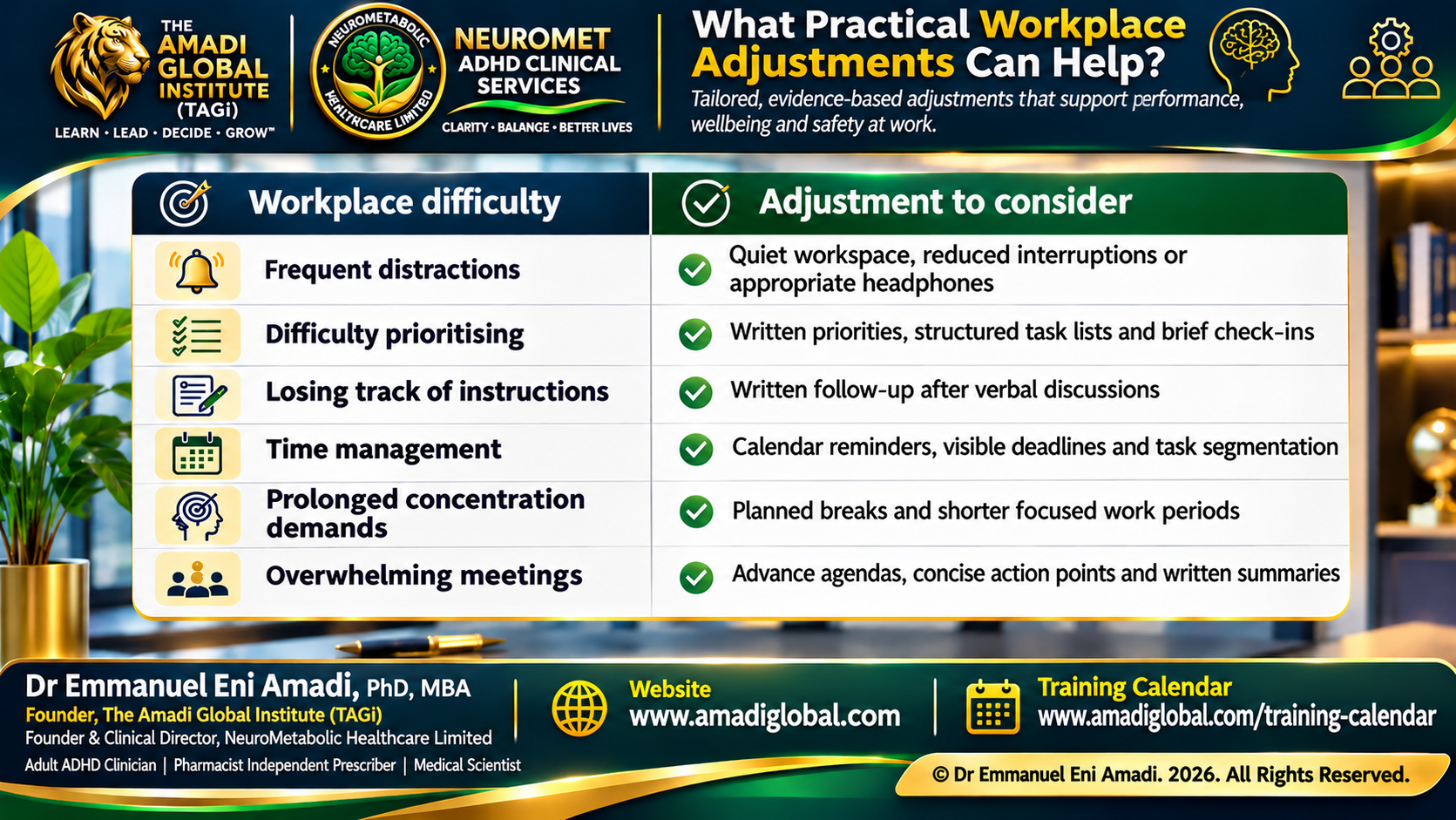
These approaches are consistent with the environmental modifications described in NICE NG87 and practical examples published by Acas. Adjustments must remain proportionate to individual needs, job requirements and safety considerations (NICE, 2018, updated 2025; Acas, 2025a; Acas, 2025b).
NICE+2
Why diagnosis still matters
Not every employee who procrastinates, loses concentration or experiences workplace stress has ADHD.
A comprehensive adult ADHD assessment should evaluate childhood onset, symptom persistence, impairment across settings, developmental and psychiatric history, and relevant differential diagnoses. Rating scales alone are insufficient to establish the diagnosis.
NICE requires diagnosis by an appropriately qualified healthcare professional with relevant training and expertise, following a full clinical and psychosocial assessment (NICE, 2018, updated 2025).
For adults whose symptoms cause significant impairment, appropriate clinical care may involve psychoeducation, environmental modifications, medication where indicated, and structured psychological support.
A message to employers and leaders
An inclusive workplace does not mean abandoning performance standards.
It means recognising that people may require different approaches to demonstrate competence and meet legitimate professional expectations.
Managers can contribute by establishing clear objectives, reducing unnecessary ambiguity, discussing practical barriers and reviewing agreed adjustments.
The strongest workplace culture is one in which employees can be held accountable while also being supported appropriately.
My Final reflection
Professional success does not invalidate ADHD. Equally, ADHD does not define the limits of professional success.
The clinical and organisational challenge is to recognise genuine impairment without reducing individuals to their diagnosis.
Understanding ADHD at work is therefore not merely a clinical issue. It is also a question of leadership, occupational wellbeing and evidence-informed management.
Dr Emmanuel Eni Amadi, PhD, MBA
Founder, The Amadi Global Institute (TAGi) | Founder & Clinical Director, NeuroMetabolic Healthcare Limited
Adult ADHD Clinician | Pharmacist Independent Prescriber | Medical Scientist
Professional disclosure: The author's ADHD assessment experience during prescribing training included supervised clinical activities. This article does not represent that those activities constituted independent ADHD diagnosis.
Clinical disclaimer: This article provides general educational information and does not replace individual medical assessment, occupational health advice or legal advice.
References
1. Acas (2025a) Adjustments for neurodiversity. Available at: https://www.acas.org.uk/reasonable-adjustments/adjustments-for-neurodiversity (Accessed: 22 November 2026).
2. Acas (2025b) What reasonable adjustments are. Updated 30 January 2025. Available at: https://www.acas.org.uk/reasonable-adjustments (Accessed: 22 November 2026).
3. Great Britain (2010) Equality Act 2010. Available at: https://www.legislation.gov.uk/ukpga/2010/15/contents (Accessed: 22 November 2026).
4. Hotte-Meunier, A. et al. (2024) ‘Strengths and challenges to embrace attention-deficit/hyperactivity disorder in employment—A systematic review’. Available at: https://doi.org/10.1177/27546330241287655.
5. Lauder, K., McDowall, A. and Tenenbaum, H.R. (2024) ‘A meta-analysis of pharmacological and psychosocial interventions aiming to improve work-relevant outcomes for adults with ADHD’. Available at: https://doi.org/10.1177/27546330241292984.
6. National Institute for Health and Care Excellence (NICE) (2018, updated 2025) Attention deficit hyperactivity disorder: diagnosis and management. NICE guideline NG87. Available at: https://www.nice.org.uk/guidance/ng87 (Accessed: 22 November 2026).