

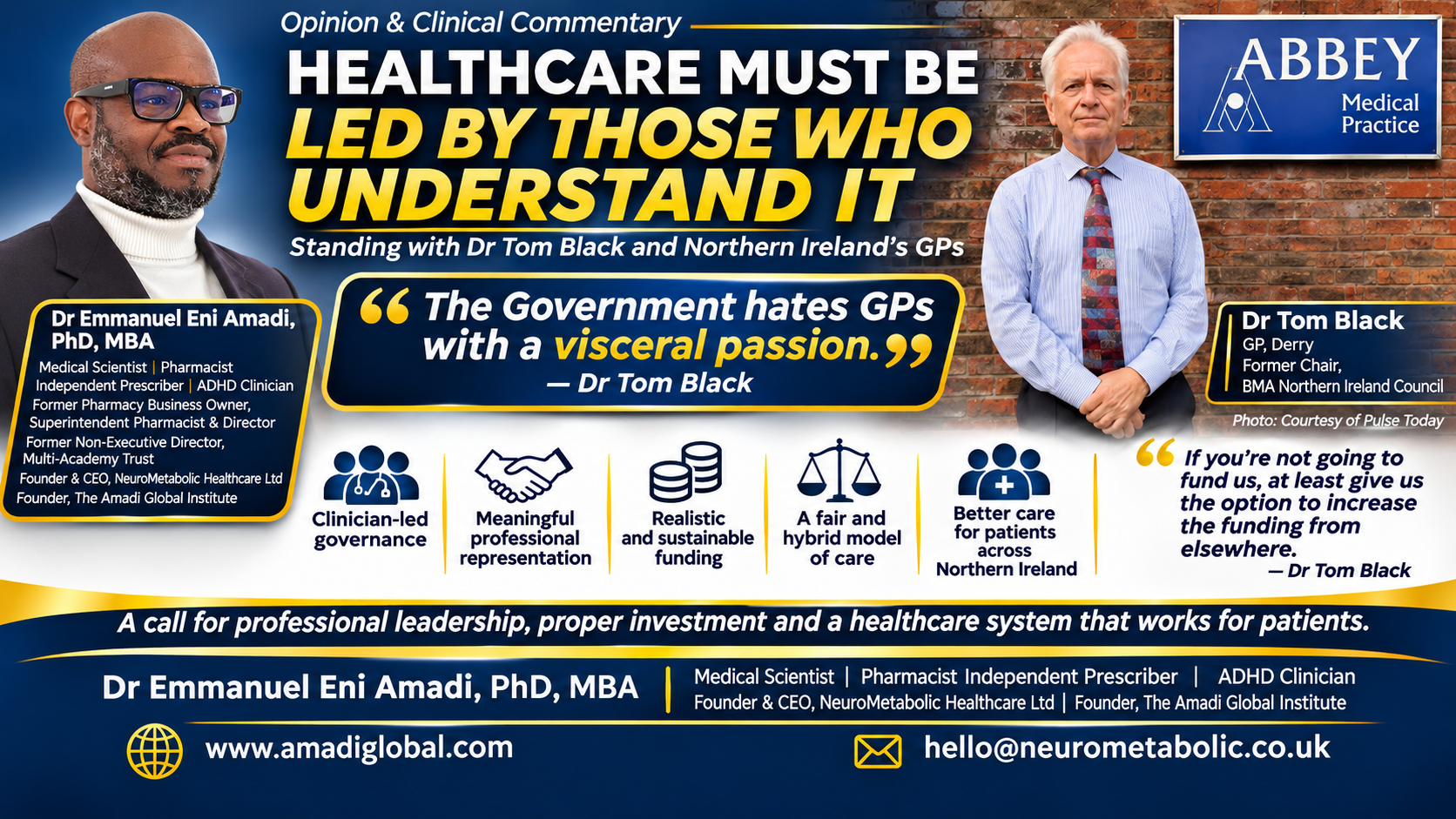
Clinical leadership, business experience, education governance and the future of healthcare policy in Northern Ireland and across the United Kingdom
By Dr Emmanuel Eni Amadi, PhD, MBA
Medical Scientist | Pharmacist Independent Prescriber | ADHD Clinician
Former Pharmacy Business Owner & Superintendent Pharmacist Director.
Former Non-Executive Director and Trustee, Multi-Academy Trust - Greater Manchester
Invited International Scientific Speaker on Nanoparticles | DNA Damage | Lung Cancer | COPD & Asthma.
Founder, The Amadi Global Institute - TAGi - Glasgow & Manchester, UK.
Founder and Clinical Director, NeuroMetabolic Healthcare Ltd.
Who should shape the future of healthcare: political decision-makers or the professionals who understand how healthcare actually works?
Dr Tom Black's warning about Northern Ireland's GP funding crisis raises urgent questions about healthcare leadership across the United Kingdom, government accountability, professional regulation and the sustainability of clinical services.
Drawing on experience across healthcare, pharmacy business ownership, scientific research, non-executive education governance and executive leadership, Dr Emmanuel Eni Amadi examines why governments must give experienced clinicians and healthcare business leaders meaningful influence over decisions affecting patients, professionals and healthcare organisations.
This independent commentary explores the future of healthcare governance, the responsibilities of regulators including the GPhC and NMC, and the importance of combining clinical expertise, business competence and democratic accountability in public policy.
When Silence Is No Longer an Option
I was born in the former Republic of Biafra, in what is now southeastern Nigeria. I am a Nigerian-born British citizen and healthcare professional whose clinical career has taken me across Nigeria, England, North Wales and Scotland.
My clinical career began in Nigeria, where I gained professional experience working in teaching hospitals in eastern Nigeria. After moving to the United Kingdom in 2002, my early professional development included pre-registration training at Ealing Hospital, Uxbridge Road, Southall, Middlesex, UB1 3HW, in West London.
I subsequently gained extensive clinical experience across England, including London, Brighton, Littlehampton, Feltham, Manchester, Liverpool, and Llandudno in North Wales, as well as undertaking locum assignments across North Wales and other parts of England.
For the past four years, I have been based in Glasgow, Scotland, with professional assignments extending across Glasgow, Edinburgh, Perth, Fife, Livingston and surrounding communities. I have travelled a lot across the UK to speak with business leaders, managers and their teams.
My perspective is shaped not only by frontline clinical practice but also by scientific doctoral research experience, business ownership, executive responsibility, education governance, international academic engagement, and more than 5 decades of life experience where “The philosophy of life” meets common sense.
As a former pharmacy business owner, Superintendent Pharmacist and Director, I have experienced the responsibilities of operating a regulated healthcare business, managing staff, maintaining regulatory compliance, managing controlled drugs, overseeing financial performance, and making decisions that affect thousands of patients and employees who had crossed my path and the sustainability of essential healthcare services.
My leadership experience also extends into the education sector. I served as a founding Non-Executive Director and Trustee of The Oak Learning Partnership Multi-Academy Trust in Greater Manchester, England, contributing to organisational strategy, governance, financial oversight, risk management, executive accountability and educational standards. My responsibilities included participation in governance structures concerned with audit, remuneration, school performance and institutional development.
My academic background adds a further dimension. I hold a PhD in Medical Sciences, specialising in nanotoxicology, with research examining the effects of graphene oxide nanoparticles on human DNA, oxidative stress and pulmonary disease.
My research has supported international scientific engagement, including invited presentations and academic engagements in the United States, Poland and the United Kingdom (Boston, Massachusetts; the University of Montana; the University of Silesia, Poland; and academic institutions in the United Kingdom). My specialist research interests include nanotoxicology, graphene oxide nanoparticles, genotoxicity, DNA damage, oxidative stress, lung cancer, chronic obstructive pulmonary disease, asthma and translational biomedical science.
As Founder of The Amadi Global Institute - Glasgow & Manchester - I also work at the intersection of executive education, organisational leadership, business strategy and professional development.
These combined experiences across healthcare, scientific research, business ownership, education governance and executive leadership have strengthened my conviction that effective leadership must be grounded in professional competence, practical experience, strategic judgement and accountability—not simply political appointment or positional authority.
There is a fundamental difference between designing a policy from an office and being personally responsible for implementing it in an organisation where staff must be paid, services delivered, regulatory obligations fulfilled and the consequences of poor decisions managed.
I am not a GP, physician or dentist, nor have I practised in Ireland. I am a medical scientist by research, a father of 2 children, a husband, and a Pharmacist Independent prescriber and ADHD Clinician whose perspective comes from within the wider healthcare profession.
My mum’s discipline, as an “IGBO Woman” when I was a child in Africa, has shaped my understanding of dignity, resilience, professional independence, and the responsibility to challenge institutions when they fail the people they are established to serve.
I have reached a stage in my professional and personal life when silence is no longer an option. Since moving to Scotland, I and other people who attended to my clinical services had severely complaints how difficult it is to get a GP appointment for what they classify an life defying situations, but are not considered urgent by GPs due to GP's workoverload in Scotland.
On 20 November 2026, Pulse Today published an interview with Dr Tom Black, a GP in Derry and former chair of the British Medical Association's Northern Ireland Council.
The headline was striking:
“The Government hates GPs with a visceral passion.”
Those words are provocative. But beneath them lies a question that every government, health minister, senior civil servant, regulator and healthcare executive should confront:
How can people who have never delivered clinical care, managed a healthcare workforce or operated a healthcare business make decisions that determine whether those services survive?
The question is not whether non-clinicians should participate in healthcare leadership. They should.
The question is whether political authority and administrative expertise have been allowed to substitute for the clinical and operational understanding required to govern healthcare effectively.
1. Healthcare Is Not Simply a Government Department. It Is a Complex Clinical and Economic System.
Healthcare is one of the most complex sectors of any national economy.
It combines clinical science, professional regulation, workforce management, pharmaceutical supply chains, technology, infrastructure, public finance, private enterprise and the ethical responsibility to protect human life.
A decision made at government level can influence thousands of healthcare organisations, millions of patients and billions of pounds in expenditure.
Yet the consequences of those decisions are often experienced most directly by clinicians, patients and the businesses responsible for delivering services.
Governments may determine funding allocations, workforce priorities, contractual arrangements and regulatory frameworks.
But healthcare professionals must translate those decisions into clinical reality.
A GP must decide whether a patient requires urgent investigation.
A pharmacist must identify potentially harmful drug interactions and ensure safe medication supply.
A nurse must recognise clinical deterioration while managing competing demands.
A dentist must provide safe treatment within the financial and regulatory constraints of practice.
A healthcare business owner must ensure that the organisation remains financially viable while meeting its professional obligations.
These responsibilities cannot be understood through financial spreadsheets alone.
Healthcare policy must be informed by those who understand both the science of care and the economics of delivering it.
2. Dr Tom Black's Warning: When Political Principles Are Not Matched by Financial Reality
Dr Black's interview highlights the growing tension between the principles of publicly funded healthcare and the resources required to sustain it.
He argues that Northern Ireland's general practices have been expected to deliver increasingly complex services without sufficient investment.
He questions whether governments can continue to promise universal healthcare while failing to provide the workforce, premises and funding necessary to deliver it.
His challenge is captured in one question:
“Are they going to fund us more?”
Dr Black argues that the proportion of healthcare funding reaching general practice is substantially below what he considers necessary.
Those funding comparisons are his assessment and should be independently examined rather than accepted without scrutiny.
Nevertheless, the underlying concern is legitimate.
When the cost of delivering healthcare rises faster than the resources available, organisations face difficult choices.
They may reduce staffing, restrict services, delay investment or absorb financial losses.
Eventually, some become unsustainable.
This is not simply a matter of professional dissatisfaction.
It is a matter of patient access, workforce stability and public safety.
A government cannot indefinitely demand more healthcare while providing insufficient resources to deliver it.
3. Political Authority Is Not the Same as Healthcare Leadership
One of the most serious weaknesses in public administration is the assumption that appointment to political office automatically provides the knowledge necessary to direct a complex industry.
A minister may be an effective politician, communicator or parliamentary representative without having worked in healthcare.
A senior official may understand public administration without having managed a clinical service.
A policymaker may have substantial academic qualifications without ever having been responsible for the financial survival of a business.
None of these backgrounds automatically disqualifies someone from leadership.
But neither does political appointment automatically confer expertise in clinical practice, business operations or healthcare economics.
Consider the responsibility of running a pharmacy business.
The owner must understand cash flow, staffing costs, professional indemnity, medicine procurement, contractual obligations, regulatory inspections, patient complaints, operational risk and financial sustainability.
A poor decision can threaten the business, the livelihoods of employees and continuity of care for patients.
The same applies to general practices, dental surgeries, nursing services, diagnostic centres and independent clinics.
Yet policies affecting these organisations may be designed by people who have never carried comparable responsibilities.
The danger arises when decision-making authority is separated from practical understanding and accountability.
A government official who has never operated a business can still contribute valuable expertise. But decisions affecting the survival of healthcare businesses should be shaped by people who understand the consequences of those decisions.
That means experienced clinicians, healthcare entrepreneurs, financial specialists, service managers, patient representatives and independent experts working together.
Political leaders should establish public priorities and remain democratically accountable.
They should not assume that political authority alone is sufficient to determine the clinical and operational details of healthcare delivery.
A Message to Government
“Political office gives a person the authority to make decisions. It does not automatically give them the experience to understand their consequences. When governments direct healthcare organisations worth billions, clinical expertise and real business experience must be present where those decisions are made—not consulted only after the policies have been written.”
— Dr Emmanuel Eni Amadi, PhD, MBA
4. Why Experience Across Healthcare, Business, Science and Education Governance Matters
I have experienced leadership and accountability from different positions within complex organisations.
As a practising clinician in the UK, I understand the importance of professional judgement, safe prescribing, appropriate investigations and continuity of care.
As a former pharmacy business owner, Superintendent Pharmacist and Director, I understand the pressures of operating a regulated healthcare organisation.
I have been responsible for managing people, maintaining professional standards, overseeing business operations and ensuring that commercial decisions remain compatible with patient safety.
As a founding Non-Executive Director and Trustee of a Multi-Academy Trust, I have contributed to strategic oversight, educational governance, executive scrutiny, financial accountability and institutional development.
My scientific research has also required the application of rigorous evidence, critical analysis, ethical responsibility and the communication of complex findings to specialist audiences.
These experiences have taught me that leadership challenges are rarely confined to a single sector.
In healthcare, poor governance can compromise patient safety.
In education, ineffective oversight can undermine learning outcomes and institutional performance.
In business, weak strategic decisions can threaten employment, investment and organisational survival.
In scientific research, inadequate scrutiny can undermine evidence, innovation and public confidence.
Across all these sectors, one principle remains consistent:
Leadership must combine specialist knowledge with the ability to make sound strategic decisions and accept responsibility for their consequences.
A healthcare organisation cannot deliver excellent clinical care if its operational and financial foundations are continually undermined.
Staff cannot be retained without sustainable funding.
Clinical services cannot expand without investment.
Regulatory obligations cannot be met without appropriate systems, training and resources.
And patients cannot receive reliable care from organisations that are constantly struggling to survive.
Financial competence is not the enemy of compassionate healthcare.
It is one of the conditions necessary to sustain it.
Similarly, business ownership, academic qualifications or non-executive experience do not automatically make someone an effective leader.
Effective leadership requires ethical judgement, governance competence, strategic vision, operational understanding and accountability.
The strongest leaders understand how these responsibilities interact.
This is the leadership capability that governments and healthcare systems should deliberately cultivate.
5. Healthcare Professions Must Have a Meaningful Voice in Their Own Governance
My concern extends beyond general practice.
It applies to medicine, pharmacy, nursing, midwifery, dentistry and allied health professions.
The United Kingdom's professional regulators include:
The General Pharmaceutical Council (GPhC).
The Nursing and Midwifery Council (NMC).
The General Medical Council (GMC).
The General Dental Council (GDC).
The Health and Care Professions Council (HCPC).
These organisations influence professional standards, education, registration, fitness to practise and public confidence.
Their statutory responsibility is to protect the public - and the public are human beings.
That responsibility must remain paramount.
However, independent regulation should not mean that the professions being regulated have insufficient influence over the development of professional standards and regulatory policy.
Pharmacists understand the practical realities of pharmacy services.
Nurses and midwives understand the pressures of clinical staffing, professional accountability and direct patient care.
Doctors understand the responsibilities associated with diagnosis, treatment and clinical decision-making.
Dentists understand the operational and clinical demands of dental practice.
Allied health professionals understand the specialist services they provide.
These perspectives must be represented meaningfully within governance and policy development.
I believe professional expertise should be a substantial consideration in appointments to relevant leadership and advisory positions, supported by transparent selection procedures, independent scrutiny and strong public representation.
Professional representative organisations should also allow members meaningful participation in selecting and holding their leaders accountable.
Statutory regulators have different legal responsibilities and appointment arrangements, so their governance must preserve independence and public protection rather than operate as elected professional trade unions.
The goal is not professional self-interest. It is better-informed regulation and safer healthcare.
“A profession should never become a passenger in decisions about its own future. The people who understand its science, practise its standards and carry its responsibilities must have a meaningful voice in shaping its leadership and governance.”
— Dr Emmanuel Eni Amadi, PhD, MBA
6. The Difference Between Political Leadership and Professional Leadership
Government leadership and professional leadership serve different purposes.
Political leaders are responsible for setting national priorities, allocating public resources and remaining accountable to the electorate.
Professional leaders are responsible for applying specialist knowledge, maintaining standards and guiding the safe delivery of services.
Neither can replace the other.
A health minister does not need to be a doctor to serve effectively.
But a health minister must be willing to listen to clinicians, understand the operational consequences of policy and appoint competent people to lead specialist services.
Similarly, a clinician does not automatically possess the skills required to manage a national health system.
Effective leadership requires additional capabilities in strategy, finance, governance, workforce management, organisational development and public policy.
This is why leadership development within healthcare professions is so important.
We should not wait until experienced clinicians become frustrated with the system before inviting them into positions of influence.
We should deliberately prepare healthcare professionals for executive responsibility.
Doctors, pharmacists, nurses, dentists and allied health professionals should have access to structured leadership education, business training, governance development and opportunities to contribute to national policy.
The strongest healthcare leadership combines:
Clinical expertise + Business competence + Scientific understanding + Strategic leadership + Public accountability.
That combination should be the objective of healthcare leadership development.
7. Dr Black's Hybrid Healthcare Proposal: A Question of Sustainability, Not Ideology
Dr Black argues that Northern Ireland may need to consider a hybrid model combining public funding with additional private income.
He draws comparisons with dentistry and the Republic of Ireland.
In his interview, he describes how his own practice introduced a limited private service when financial pressures threatened its sustainability.
According to his account, the additional income helped address financial difficulties.
His argument is not simply that private healthcare is preferable.
It is that a publicly funded service cannot remain sustainable if its funding does not reflect the cost of providing care.
That concern deserves serious consideration.
However, hybrid healthcare is not a universal solution.
Additional private income can help some organisations, but it can also introduce inequalities in access.
Patients who can afford additional charges may obtain faster treatment, while those who cannot pay may face disadvantages.
Differences between healthcare systems must also be evaluated carefully. Better outcomes in one jurisdiction cannot automatically be attributed to its funding model.
The correct question is therefore not whether public healthcare is inherently superior to private healthcare, or vice versa.
The correct question is:
Which arrangements deliver the safest, most equitable and most sustainable care for the population?
That question requires evidence, transparent financial modelling, meaningful professional engagement and careful consideration of patient outcomes.
Governments should be willing to examine different models without allowing political ideology to determine the answer in advance.
8. Healthcare Businesses Are Partners in Public Health, Not Merely Commercial Enterprises
Independent pharmacies, GP practices, dental surgeries, community clinics and other healthcare providers are businesses.
But they are not ordinary businesses.
They operate within regulated environments and carry responsibilities that extend beyond commercial performance.
They employ healthcare professionals, invest in infrastructure, support local economies and provide essential services to communities.
Many operate with limited financial margins while meeting substantial regulatory obligations.
When government policy increases operating costs, changes reimbursement arrangements or introduces new compliance requirements, the effects can be significant.
A policy that appears financially efficient at the national level may make individual services economically unsustainable.
That is why government must engage seriously with healthcare business owners and operational leaders.
Consultation should not become a procedural exercise conducted after major decisions have already been made.
Healthcare entrepreneurs and experienced service operators should contribute to policy development at an early stage.
Their experience can identify risks that may not be visible in national financial models.
They can explain how changes affect staffing, investment, patient access and business continuity.
A healthcare policy that ignores operational reality risks becoming a policy that cannot be delivered.
This is equally relevant to large hospital organisations and small community healthcare businesses.
The scale differs.
The principle does not.
9. Patients Must Remain at the Centre of Every Decision
Dr Black's interview is particularly compelling when he discusses the patients served by his practice in the Bogside area of Derry.
He describes the difficulties faced by disadvantaged communities and the consequences of limited healthcare resources.
He also recounts a serious incident involving a patient with a suspected heart attack and an initially prolonged ambulance response estimate.
That is his reported experience, not an independently verified measure of ambulance performance across Northern Ireland.
Nevertheless, the account illustrates the human consequences of healthcare capacity problems.
Funding debates can become dominated by percentages, contracts and political disagreements.
But behind those discussions are patients who need timely investigations, safe treatment and continuity of care.
The purpose of healthcare reform must never be reduced to protecting institutional structures.
It must be to protect people.
A financially sustainable service that excludes vulnerable patients is not an acceptable outcome.
Neither is a theoretically universal service that lacks the resources to provide timely, safe care.
The challenge for government is to reconcile financial sustainability with equitable access and clinical quality.
That requires leadership capable of understanding all three.
10. Government Must Move from Consultation to Shared Responsibility
Healthcare professionals are frequently invited to consultations, committees and advisory groups.
These mechanisms can be valuable.
But consultation is not the same as influence.
If clinicians and experienced healthcare business leaders are invited to comment only after policy priorities have already been established, their contribution may be limited.
Meaningful participation requires earlier engagement.
It requires transparent decision-making, access to relevant evidence and a willingness to revise proposals when frontline experience reveals serious weaknesses.
I would encourage governments and healthcare organisations to adopt five principles.
First, place clinical expertise at the centre of healthcare policy. Major decisions affecting patient safety, professional practice and service delivery should be informed by appropriately qualified clinicians.
Second, incorporate genuine business and operational experience. Those who have managed healthcare organisations should help assess the practical and financial consequences of proposed reforms.
Third, strengthen professional representation and accountability. Regulatory and representative organisations should provide meaningful opportunities for professionals to influence decisions affecting their work, while preserving independent public protection.
Fourth, invest in leadership development. Healthcare professionals with the necessary aptitude should be supported to develop executive, financial, governance and strategic capabilities.
Fifth, measure policy success through patient outcomes and service sustainability. Political announcements and budget allocations are not sufficient measures of success.
A reform should ultimately be judged by whether patients receive safer, more accessible and more effective care.
11. Northern Ireland's Future Must Be Built on Evidence and Professional Trust
Dr Black predicts that political developments could eventually lead to an integrated healthcare system across the island of Ireland.
That is his forecast, not an established outcome.
Any constitutional or healthcare-system changes would require democratic legitimacy, detailed planning and careful consideration of funding, workforce arrangements and patient rights.
The immediate challenges are more pressing.
Northern Ireland must address the sustainability of general practice, the pressures on its workforce and the relationship between government and frontline healthcare professionals.
The recently agreed GP contract provides an opportunity for further discussion.
But financial settlements alone cannot restore professional trust.
Trust requires evidence that government understands the realities of healthcare delivery.
It requires clinicians to be treated as partners rather than obstacles.
And it requires healthcare leaders to accept responsibility for the practical consequences of their decisions.
12. My Message to Government, Policymakers and Healthcare Leaders
I support Dr Tom Black's willingness to challenge the sustainability of Northern Ireland's current arrangements.
I do not necessarily agree with every element of his proposed hybrid model.
But I agree that healthcare professionals must be heard when they warn that the systems in which they work are becoming increasingly difficult to sustain.
My own perspective comes from clinical practice, medical science, scientific research, business ownership, executive responsibility and non-executive governance.
I have worked within healthcare systems.
I have managed a regulated healthcare business.
I have carried responsibility for staff, professional standards, operational performance and financial sustainability.
I have contributed to the governance and strategic oversight of a Multi-Academy Trust.
I have also engaged with international scientific and academic audiences on research involving nanotoxicology and the biological effects of advanced nanomaterials.
These experiences have convinced me that effective healthcare leadership cannot depend on political appointment or administrative authority alone.
Governments should govern. Clinicians should shape clinical policy. Experienced operational leaders should inform service design. Scientists should contribute evidence. And patients should remain the ultimate beneficiaries.
This is not a call to exclude politicians, civil servants or non-clinical professionals.
It is a call for a better distribution of expertise and responsibility.
Political leaders can provide democratic legitimacy and national direction.
Financial specialists can support responsible resource allocation.
Experienced clinicians can explain what safe and effective care requires.
Scientists and researchers can contribute rigorous evidence.
Healthcare business leaders can identify whether proposed services are operationally sustainable.
Together, they can create stronger institutions.
But when any one group assumes it can govern the entire system without meaningful engagement with the others, the consequences can be serious.
“The greatest failure of leadership is not the absence of authority. It is the exercise of authority without understanding. In healthcare, that failure is measured not only in financial losses but in delayed treatment, exhausted professionals, failing services and avoidable harm to patients.”
— Dr Emmanuel Eni Amadi, PhD, MBA
Conclusion: Leadership Must Be Earned Through Competence, Not Assumed Through Position
Dr Tom Black's interview should be read as more than a criticism of government.
It is a warning about what happens when the relationship between political authority, professional expertise and operational reality breaks down.
Healthcare systems cannot be sustained by political promises alone.
They require adequate resources, competent management, professional trust and leaders who understand the consequences of their decisions.
The future of healthcare must not be determined exclusively by people who have never delivered clinical care, managed healthcare organisations or carried responsibility for their financial survival.
Equally, clinical experience alone is not sufficient to govern complex national systems.
The solution is leadership that combines clinical understanding, operational experience, scientific evidence, strategic competence and democratic accountability.
Professional regulators must protect the public while maintaining meaningful engagement with the professions they regulate.
Governments must recognise healthcare businesses as essential partners in service delivery.
And healthcare professionals must be prepared and empowered to contribute to leadership at the highest levels.
My final message is this:
“Do not place the future of healthcare solely in the hands of those who hold political authority but lack the experience to understand its consequences. Bring experienced clinicians, healthcare business leaders, scientists and competent professionals into the rooms where decisions are made. A healthcare system is strongest when those who understand it help to lead it.”
— Dr Emmanuel Eni Amadi, PhD, MBA
The people responsible for delivering healthcare deserve a meaningful voice in shaping its future.
And the patients who depend upon them deserve nothing less.
References and Further Reading
Pulse Today (2026). ‘Dr Tom Black: The Government hates GPs with a visceral passion’. Interview by Sofia Lind, 20 November 2026. https://www.pulsetoday.co.uk/special/big-interviews/dr-tom-black-the-government-hates-gps-with-a-visceral-passion/
Pulse Today (2026). ‘BMA accepts Northern Ireland GP contract offer putting an end to collective action’. 10 November 2026.
Pulse Today (2026). ‘BMA must support GP practices who want to leave GMS, says NI LMCs’. 16 November 2026.
General Pharmaceutical Council. Our role and regulatory responsibilities. https://www.pharmacyregulation.org/
Nursing and Midwifery Council. Our role. https://www.nmc.org.uk/
General Medical Council. About the GMC. https://www.gmc-uk.org/
General Dental Council. About us. https://www.gdc-uk.org/
Health and Care Professions Council. About us. https://www.hcpc-uk.org/
About the Author
Dr Emmanuel Eni Amadi, PhD, MBA is a Nigerian-born British medical scientist, pharmacist independent prescriber, ADHD clinician, healthcare entrepreneur, executive educator and international scientific speaker.
His professional career spans healthcare practice in Nigeria, England, North Wales and Scotland, including teaching hospitals in eastern Nigeria and pre-registration training at Ealing Hospital in West London.
He holds a PhD in Medical Sciences, specialising in nanotoxicology, and an Executive MBA. His scientific research examines graphene oxide nanoparticles, genetic toxicity and their potential implications for human health.
He has participated in invited scientific presentations and international academic engagements in the United States, Poland and the United Kingdom (Boston, Massachusetts; University of Montana; University of Silesia, Poland; and UK academic institutions), with research interests spanning nanotoxicology, genotoxicity, DNA damage and pulmonary disease.
He is a former pharmacy business owner, Superintendent Pharmacist and Director, and served as a founding Non-Executive Director and Trustee of The Oak Learning Partnership Multi-Academy Trust, Greater Manchester.
He is the Founder and Clinical Director of NeuroMetabolic Healthcare Ltd, Glasgow, and Founder of The Amadi Global Institute, an executive education organisation focused on leadership, strategic thinking, business growth and professional development.
Areas of expertise and speaking engagements: Healthcare leadership and governance; healthcare policy and professional regulation; pharmacy business leadership; strategic thinking and executive decision-making; non-executive board governance; educational leadership; healthcare entrepreneurship; scientific innovation; nanotoxicology; graphene oxide nanoparticles; genotoxicity; DNA damage; pulmonary disease; translational biomedical science; and leadership development.
Website: https://www.amadiglobal.com
Email: hello@neurometabolic.co.uk
Author's note: This article is an independent professional commentary. Quotations and experiences attributed to Dr Tom Black are drawn from his interview published by Pulse Today on 20 November 2026. The policy recommendations, leadership principles and original quotations attributed to Dr Amadi represent the author's own views. The article does not imply endorsement by Dr Black, Pulse Today or any professional regulator.