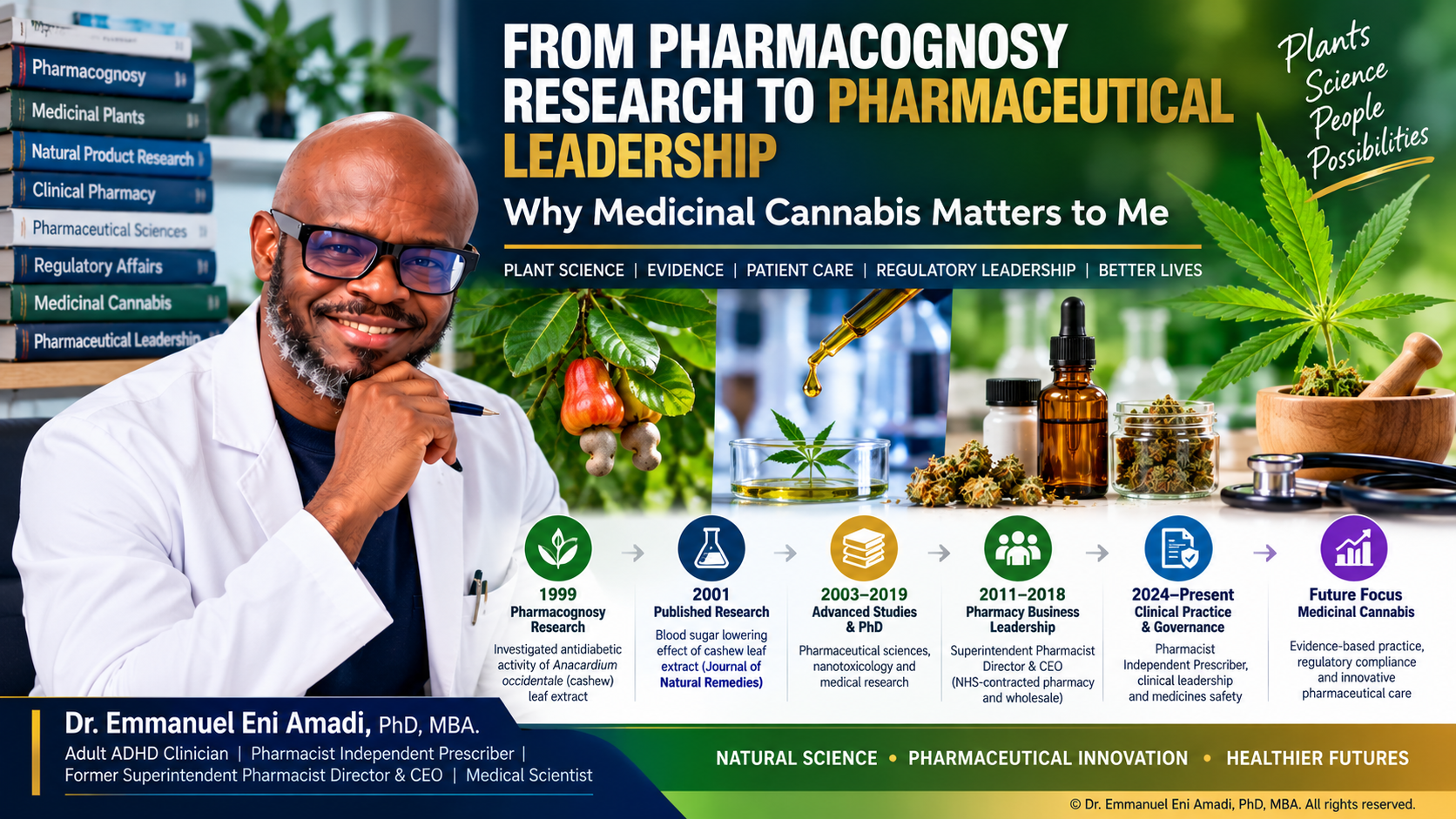
Dr. Emmanuel Eni Amadi pictured alongside pharmacognosy research, cashew leaves, medicinal cannabis products and a timeline illustrating his journey from plant-derived medicines research in 1999 to pharmaceutical leadership and clinical governance.
An Evidence-Based Professional Perspective on Plant-Derived Therapeutics, Pharmaceutical Governance and Leadership in the Emerging Medicinal Cannabis Sector.
Dr. Emmanuel Eni Amadi, PhD, MBA
Pharmacist Independent Prescriber | Former Superintendent Pharmacist Director & CEO | Medical Scientist | Pharmaceutical Executive
21 October 2026.
My Interest Began in 1999 — Long Before Medicinal Cannabis Entered the UK Mainstream
My interest in medicinal cannabis did not begin with the expansion of the UK private cannabis industry. Its scientific foundations can be traced to 1999, when I undertook my undergraduate pharmacognosy research at the University of Nigeria, Nsukka.
My research investigated the potential antidiabetic activity of an aqueous leaf extract of Anacardium occidentale L., commonly known as the cashew tree.
The project, titled Pharmacological Investigation of the Antidiabetic Activity of Aqueous Leaf Extract of Anacardium occidentale L., involved experimental investigations using rabbit models.
The work explored an important pharmacological question: could biologically active compounds derived from medicinal plants demonstrate measurable therapeutic effects?
Related findings were subsequently published in the Journal of Natural Remedies in 2001, under the title Blood Sugar Lowering Effect of Anacardium occidentale Leaf Extract in Experimental Rabbit Model [1].
That early research helped establish my interest in natural-product pharmacology and the scientific evaluation of plant-derived medicines.
It is important to distinguish the two fields: my undergraduate research investigated cashew-leaf extracts, not cannabis. Nevertheless, the underlying scientific principles—pharmacological activity, dose-response relationships, safety and therapeutic evaluation—remain highly relevant to cannabinoid-based medicines.
From Laboratory Research to Pharmaceutical Governance

My professional development subsequently extended beyond experimental pharmacology.
I completed postgraduate studies in analytical and pharmaceutical sciences, followed by a PhD in Medical Sciences, specialising in nanotoxicology.
My doctoral research (PhD) at the University of Bradford, England (Dec 2019) focused on the nanotoxicology of nanoparticles used in cancer treatment, or simply, the effects of graphene oxide nanoparticles on human DNA post-exposure to human blood samples in patients with lung cancer, asthma and COPD relative to healthy volunteers, thereby strengthening my experience in experimental methodology, toxicological assessment and the interpretation of scientific evidence.
Alongside my academic career, I established and led an NHS-contracted distance-selling pharmacy and pharmaceutical wholesale business in Manchester.
As Superintendent Pharmacist Director and CEO, I held responsibility for pharmaceutical governance, medicines supply, regulatory compliance, operational leadership and business development.
The business achieved annual turnover exceeding 6 figures in revenue and employed a workforce of more than 50 people.
This combination of research training and executive pharmacy leadership has shaped my understanding of pharmaceutical innovation.
Scientific potential creates opportunity. Effective governance determines whether that opportunity can be translated into safe and sustainable patient care.
Why Medicinal Cannabis Interests Me Today
The development of cannabis-based medicinal products represents an important intersection between pharmacognosy, pharmaceutical science, clinical therapeutics and medicines regulation.
The UK's 2018 legislative changes created a regulated pathway for access to certain cannabis-based medicinal products [2].
However, clinical evidence, product quality, specialist prescribing restrictions and patient safety remain central considerations.
NICE guideline NG144 identifies defined circumstances in which particular cannabinoid medicines may be considered or recommended, while also highlighting important limitations in the evidence for other indications [3].
This distinction is fundamental to my professional interest.
I am interested not simply in the commercial growth of medicinal cannabis, but in the development of a pharmaceutical sector capable of demonstrating robust governance, clinical accountability and consistent quality standards.
The Role of Superintendent Pharmacist Leadership
As the medicinal cannabis industry develops, pharmacy leadership must extend beyond the traditional functions of dispensing and supply.
It requires an integrated understanding of:
Regulatory governance: GPhC standards, MHRA requirements, controlled-drug legislation and professional accountability.
Pharmaceutical quality: Product sourcing, supplier assurance, storage, traceability and quality-management systems.
Clinical safety: Prescription validation, medicines reconciliation, interactions, patient counselling and pharmacovigilance.
Operational leadership: Standard operating procedures, workforce development, risk management and service improvement.
Commercial sustainability: Building compliant, patient-centred pharmacy operations capable of responsible growth.
The GPhC requires registered pharmacies to operate safely and effectively, while the GMC and NHS England set out the specialist medical prescribing framework applicable to unlicensed cannabis-based medicinal products [4–6].
These responsibilities demonstrate why pharmaceutical governance must be embedded within a medicinal cannabis business from the outset.
My Professional Direction
I see medicinal cannabis as a sector in which my academic background, pharmaceutical business experience and clinical qualifications can contribute meaningfully.
My professional experience includes research in plant-derived therapeutics, postgraduate pharmaceutical sciences, doctoral toxicology research, independent prescribing qualification and previous superintendent-level responsibility for a regulated pharmacy business.
I do not present my background as previous specialist medicinal cannabis prescribing experience. Rather, it provides a transferable foundation for senior pharmaceutical leadership in a highly regulated and scientifically evolving sector.
I am particularly interested in Superintendent Pharmacist, Pharmaceutical Governance Director and senior pharmacy leadership opportunities within organisations committed to developing safe, evidence-led medicinal cannabis services.
Conclusion
My professional interest in medicinal cannabis is rooted in a scientific journey that began at the University of Nigeria, Nsukka, in 1999.
Over more than two decades, that foundation has developed through pharmaceutical research, clinical pharmacy, business ownership and regulatory leadership.
For me, medicinal cannabis is not simply an emerging market.
It is an opportunity to apply established pharmaceutical principles to a developing therapeutic field—while ensuring that patient safety, scientific evidence and professional accountability remain non-negotiable.
The challenge for the medicinal cannabis industry is not merely to expand access. It is to build the clinical confidence, regulatory integrity and pharmaceutical governance necessary to justify that access.
References
[1] Esimone, C.O., Okonta, J.M. and Ezugwu, C.O. (2001) ‘Blood Sugar Lowering Effect of Anacardium occidentale Leaf Extract in Experimental Rabbit Model’, Journal of Natural Remedies, 1(1), pp. 60–63. https://doi.org/10.18311/jnr/2001/64
[2] UK Government (2018) Medicinal cannabis: information and resources. https://www.gov.uk/government/collections/medicinal-cannabis-information-and-resources
[3] National Institute for Health and Care Excellence (2019) Cannabis-based medicinal products. NICE guideline NG144. https://www.nice.org.uk/guidance/ng144
[4] General Pharmaceutical Council (GPhC) (n.d.) Standards for registered pharmacies. https://inspections.pharmacyregulation.org/standards
[5] General Medical Council (GMC) (n.d.) Information for doctors on cannabis-based products for medicinal use. https://www.gmc-uk.org/professional-standards/learning-materials/information-for-doctors-on-cannabis-based-products-for-medicinal-use
[6] NHS England (2023) Cannabis-based products for medicinal use (CBPMs). https://www.england.nhs.uk/long-read/cannabis-based-products-for-medicinal-use-cbpms/
Related reading: Medicinal Cannabis: What Patients, Clinicians and the Evidence Really Say — The Amadi Global Institute.
https://www.amadiglobal.com/blog/medicinal-cannabis-benefits-risks-uk-evidence
© 2026 Dr. Emmanuel Eni Amadi, PhD, MBA. All rights reserved.
Clinical disclaimer: This article provides general educational information and is not a substitute for an individual clinical assessment, diagnosis or treatment plan.