


Adult ADHD: Can an Online Self-Assessment Really Tell You Whether You Have ADHD?
Digital Screening vs Face-to-Face Clinical Assessment — What the Evidence Says
By Dr Emmanuel Eni Amadi, PhD, MBA.
Adult ADHD Clinician | GPhC Registered Pharmacist Independent Prescriber (GPhC Reg. No: 20-65-651) | UKAAN-Trained | Medical Scientist.
Published: Sunday, 18 October 2026
Introduction: When a Questionnaire Changes How You See Yourself
Imagine spending much of your adult life wondering why you struggle to concentrate, organise your responsibilities, meet deadlines or complete tasks that appear straightforward to other people.
You may have been described as forgetful, disorganised or lacking discipline. Perhaps you have performed well professionally while privately struggling to manage everyday responsibilities.
Then, one evening, you complete an online Adult ADHD questionnaire.
Within minutes, a message appears suggesting that your answers are consistent with ADHD symptoms.
For some people, this can be an important moment of recognition. Experiences that once seemed unrelated suddenly appear connected.
But an important clinical question remains:
Does a positive online ADHD screening result mean you have ADHD?
The answer is no.
Digital self-assessment can be a useful starting point, but screening and diagnosis are fundamentally different clinical processes.
Understanding that distinction is increasingly important as more adults seek explanations for longstanding difficulties with attention, organisation, impulsivity and emotional regulation.
1. What Is an Adult ADHD Self-Assessment?
An Adult ADHD self-assessment usually involves completing a questionnaire about symptoms associated with inattention, hyperactivity and impulsivity.
One recognised instrument is the World Health Organisation Adult ADHD Self-Report Scale (ASRS).
The original ASRS was developed to help identify adults who might benefit from further clinical evaluation. It includes an 18-item symptom checklist and a shorter six-item screening version.
In their validation study, Kessler et al. (2005) demonstrated that the six-question ASRS screener could help identify possible ADHD in community populations.
A subsequent study developed an updated six-question screening approach aligned with DSM-5 criteria (Ustun et al., 2017).
These studies established the value of structured screening instruments. However, neither demonstrated that an online questionnaire could replace a comprehensive diagnostic assessment. Cambridge University Press
What does an online screening questionnaire actually measure?
Most ADHD screening questionnaires ask respondents to indicate how frequently they experience particular difficulties.
These may include problems with sustaining attention, organising activities, completing tasks, remembering appointments, managing restlessness or controlling impulsive behaviour.
The responses are then scored according to the instrument's methodology.
A result above a screening threshold indicates that further assessment may be appropriate.
It does not establish that ADHD is present, determine its severity or exclude alternative explanations.
2. Why a Positive Screening Result Is Not a Diagnosis
Consider two hypothetical adults who complete the same questionnaire.
The first has experienced significant organisational difficulties, forgetfulness and impulsivity since childhood. These problems have persisted across education, employment and personal relationships.
The second developed similar difficulties more recently, during a period of severe insomnia, anxiety and depression.
Both individuals might report difficulties concentrating, completing tasks and managing responsibilities.
Their screening results could therefore look similar.
However, the underlying clinical explanations may be very different.
ADHD is a neurodevelopmental condition. A comprehensive assessment examines the developmental history of symptoms, their persistence over time, their effects across different settings and whether another condition better explains the difficulties.
Anxiety, depression, bipolar disorder, sleep disorders and substance-related problems can produce symptoms that overlap with ADHD. Some may also coexist with ADHD.
A questionnaire cannot adequately resolve these distinctions.
This is why the NICE guideline NG87 states that ADHD should not be diagnosed solely from rating-scale scores or observational information (NICE, 2018). NICE
3. Digital Self-Assessment: The Advantages
Digital screening has practical advantages when used appropriately.
Accessibility
An online questionnaire can be completed without travelling to a clinic.
This may be particularly helpful for adults who live in rural areas, experience mobility difficulties or have demanding work and family responsibilities.
Early symptom recognition
Some adults have spent years interpreting their difficulties as personal shortcomings.
A structured questionnaire may help them recognise patterns worth discussing with a healthcare professional.
Preparation for a clinical consultation
Completing a recognised questionnaire can encourage someone to reflect on when their symptoms began, how frequently they occur and which aspects of daily life are affected.
These reflections may help them explain their concerns during a GP appointment or specialist assessment.
Efficient information gathering
Digital forms can also help services collect relevant background information before a consultation.
The independent ADHD Taskforce established by NHS England has supported greater use of digital systems to improve service efficiency and access.
However, digitalisation should improve the assessment pathway rather than substitute automated decisions for clinical judgement (NHS England, 2025). NHS England
4. The Limitations of Online ADHD Screening
Despite these advantages, digital screening has important limitations.
First, symptoms are not specific to ADHD. Difficulty concentrating may arise from several mental and physical health conditions.
Second, self-report is inherently subjective. Individuals differ in how they interpret questions, remember childhood experiences and evaluate the severity of their difficulties.
Third, questionnaires may not establish functional impairment. Reporting frequent forgetfulness does not, by itself, demonstrate the degree to which symptoms interfere with work, relationships or everyday functioning.
Fourth, a screening result does not establish the developmental pattern required for ADHD diagnosis. A clinician must investigate whether relevant symptoms were present during childhood and have persisted.
Finally, online screening cannot adequately evaluate the full differential diagnosis. This requires clinical questioning, examination of the wider history and professional judgement.
The UK Adult ADHD Network's Adult ADHD Assessment Quality Assurance Standard (AQAS) emphasises that self-completed rating scales must not replace detailed clinical exploration (Adamou et al., 2024). Frontiers
A positive questionnaire result should therefore be understood as a reason to explore symptoms further—not a clinical verdict.
5. Face-to-Face Assessment: What Makes It Different?
A face-to-face clinical assessment involves direct interaction between the patient and an appropriately qualified healthcare professional.
Unlike a self-completed questionnaire, the clinician can explore the person's experiences in detail, ask follow-up questions and clarify ambiguous responses.
For example, a patient may report difficulty concentrating.
The clinician might then explore whether this occurs during meetings, conversations, reading, household activities or tasks requiring sustained mental effort.
They may ask when the problem began, whether it was present at school, how it affects occupational functioning and whether it changes during episodes of anxiety, depression or poor sleep.
The assessment also considers the patient's developmental, psychiatric, medical and social history.
Information from someone who knows the patient well may help establish childhood symptoms or current functional difficulties, where appropriate and available.
These elements are consistent with NICE NG87 and the UKAAN AQAS recommendations (NICE, 2018; Adamou et al., 2024). NICE
Is face-to-face assessment always superior?
Not necessarily.
The quality of an ADHD assessment depends on much more than whether the patient and clinician are physically in the same room.
A brief, poorly conducted face-to-face consultation may provide less diagnostic information than a comprehensive video assessment conducted by an appropriately trained clinician.
Equally, a video consultation that consists mainly of closed questions and minimal clinical exploration would not constitute a high-quality assessment simply because a clinician was present.
The UKAAN AQAS explicitly recognises direct consultation through either face-to-face contact or videoconferencing.
The essential requirement is a sufficiently detailed clinical interview that explores symptoms, impairment and alternative explanations (Adamou et al., 2024). Frontiers
6. Can Adult ADHD Be Diagnosed Through a Video Consultation?
Yes. A comprehensive adult ADHD assessment can be conducted remotely when the circumstances are appropriate.
However, a remote diagnostic assessment is fundamentally different from completing an online self-screening questionnaire.
A video-based assessment should allow the clinician to conduct a detailed interview, explore developmental history, assess functional impairment and investigate coexisting conditions.
It should also support appropriate documentation, confidentiality and the collection of relevant collateral information.
If the remote format does not allow an adequate assessment—for example, because of communication difficulties, unresolved clinical complexity or the need for physical examination—the clinician should arrange additional assessment or an alternative consultation format.
The UKAAN AQAS recommends a detailed, semi-structured approach and suggests that an adequate adult ADHD assessment, including initial post-assessment discussion, will generally require at least two hours of clinical time. This is a quality recommendation rather than an inflexible duration applicable to every patient (Adamou et al., 2024). Frontiers
The appropriate question is therefore not simply whether the assessment takes place online or in person.
It is whether the assessment obtains sufficient reliable evidence to support a defensible clinical conclusion.
7. What Should a Comprehensive Adult ADHD Assessment Include?
According to NICE NG87, ADHD diagnosis should be made only by a specialist psychiatrist, paediatrician or another appropriately qualified healthcare professional with the necessary training and expertise.
The diagnostic process must include a full clinical and psychosocial assessment, developmental and psychiatric history, observer information and assessment of mental state.
Symptoms must meet recognised diagnostic criteria, produce clinically significant impairment and occur across relevant settings (NICE, 2018).
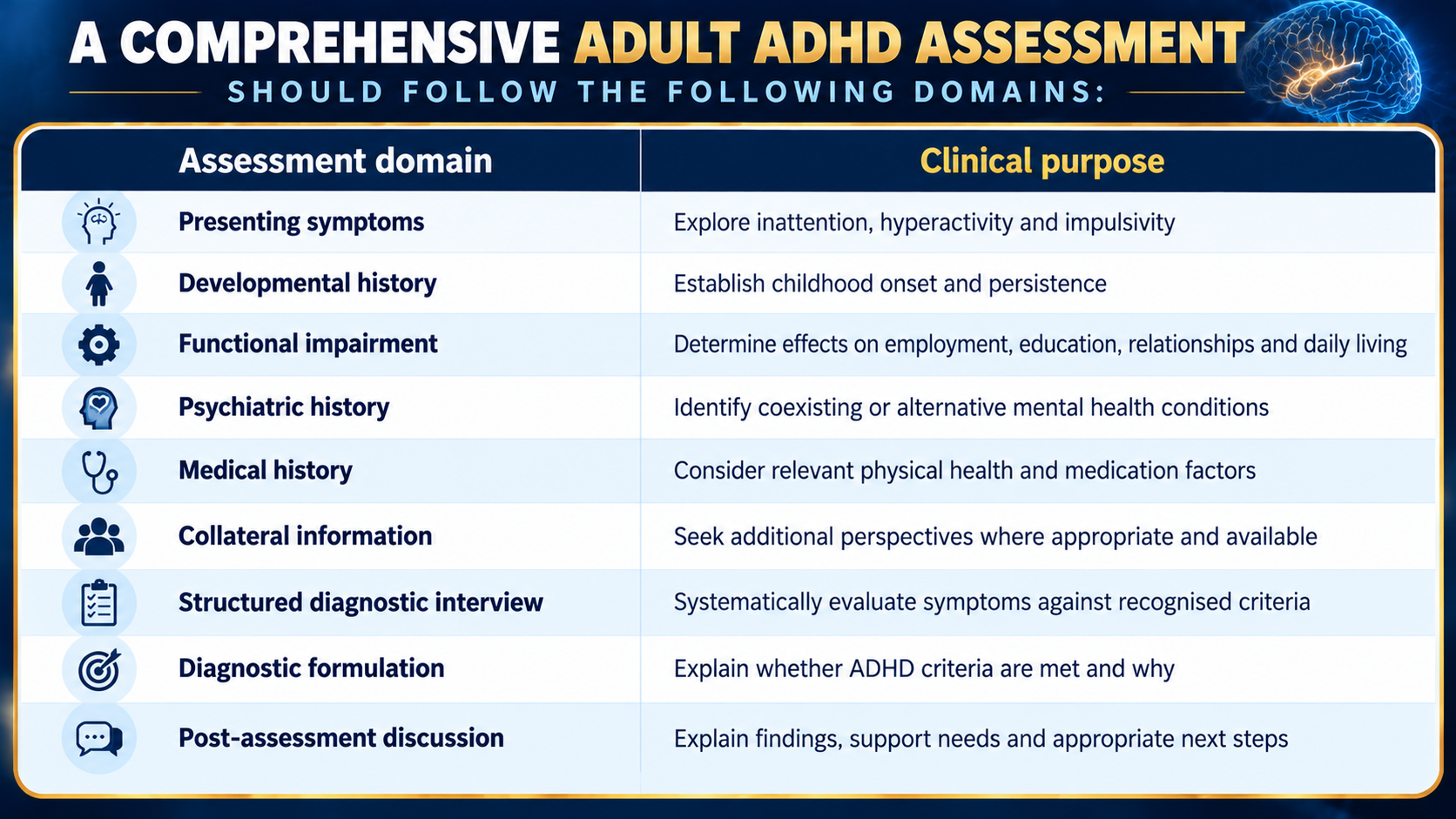
The clinician should also document important uncertainties and explain when the available evidence is insufficient to reach a confident diagnosis.
This protects patients from both missed diagnoses and inappropriate diagnostic labelling. NICE
8. What About QbTest and Other Digital ADHD Technologies?
Digital ADHD assessment is not limited to questionnaires.
Technologies such as QbTest use computerised tasks to measure aspects of attention, impulsivity and motor activity.
However, these technologies must not be confused with standalone diagnostic tests.
In its 2024 health technology guidance, NICE recommended QbTest as an option to assist diagnosis in children and young people aged 6–17 years, alongside standard clinical assessment.
NICE concluded that evidence was insufficient to recommend the evaluated technologies for routine diagnostic use in adults and called for further research.
Therefore, a computerised attention test should not be presented as definitive proof of Adult ADHD (NICE, 2024). NICE
9. What Should You Do After a Positive Online ADHD Screening Result?
If an online screening questionnaire suggests possible ADHD, the next step is to seek an appropriate clinical evaluation.
Begin by documenting the difficulties that concern you, particularly how they affect your everyday functioning.
Think about whether similar problems were present during childhood and whether they have persisted across different stages of life.
Where available, school reports, previous assessments or information from someone familiar with your childhood may help provide context.
You can then discuss your concerns with your GP or an appropriate healthcare professional, who can advise on local referral pathways.
The NHS advises adults seeking assessment to discuss their symptoms, developmental history and impact on daily life with a healthcare professional. nhs.uk
Importantly, people experiencing functional difficulties may benefit from practical support while awaiting assessment. Support does not always need to be postponed until a formal diagnosis is established.
10. The Wider Challenge: Access Without Compromising Clinical Quality
Adult ADHD services face a difficult challenge.
There is growing demand for assessment, while many people experience substantial delays in accessing specialist services.
Digital systems may help reduce administrative burdens, improve communication and make consultations more accessible.
However, the objective should not be to replace careful clinical assessment with automated questionnaires.
The objective should be to make high-quality, evidence-based assessment more accessible.
The independent ADHD Taskforce's reports, published in June and November 2025, emphasised the need for improved access, coordinated support and better use of digital technology within ADHD services (NHS England, 2025). NHS England
Digital innovation and clinical quality should be complementary objectives, not competing priorities.
Conclusion:
A Questionnaire Can Start the Conversation, but It Cannot Finish It
Online Adult ADHD self-assessment can be valuable.
It can increase awareness, encourage reflection and help individuals take the first step towards seeking appropriate support.
But a positive screening result is not a diagnosis.
A reliable diagnosis requires a comprehensive clinical evaluation that examines symptoms, developmental history, functional impairment and possible alternative explanations.
Such an assessment may be conducted face-to-face or remotely, provided the clinician and process meet appropriate professional standards.
The distinction is not simply digital versus face-to-face. It is screening versus diagnosis—and convenience versus clinical completeness.
For adults who have struggled for years without understanding why, the goal must be more than obtaining a label.
It must be obtaining the right assessment, the right explanation and access to appropriate support.
About the Author
Dr Emmanuel E. Amadi, PhD, MBA.
Adult ADHD Clinician | GPhC Registered Pharmacist Independent Prescriber (GPhC Reg. No: 20-65-651) | UKAAN-Trained in Adult ADHD | Medical Scientist.
Dr Amadi is a UK-registered pharmacist independent prescriber, medical scientist and executive educator. His professional background includes clinical pharmacy, mental health and adult ADHD screening, structured assessment and medication-review experience.
References:
Adamou, M., Arif, M., Asherson, P., Cubbin, S., Leaver, L., Sedgwick-Müller, J., Müller-Sedgwick, U., van Rensburg, K. and Kustow, J. (2024) ‘The adult ADHD assessment quality assurance standard’, Frontiers in Psychiatry, 15, 1380410. doi: 10.3389/fpsyt.2024.1380410. Full article.
Kessler, R.C., Adler, L., Ames, M., Demler, O., Faraone, S., Hiripi, E., Howes, M.J., Jin, R., Secnik, K., Spencer, T., Ustun, T.B. and Walters, E.E. (2005) ‘The World Health Organization adult ADHD self-report scale (ASRS): a short screening scale for use in the general population’, Psychological Medicine, 35(2), pp. 245–256. doi: 10.1017/S0033291704002892. Research article.
National Health Service (NHS) (n.d.) ADHD in adults. Available at: NHS ADHD information (Accessed: 18 October 2026).
National Institute for Health and Care Excellence (NICE) (2018) Attention deficit hyperactivity disorder: diagnosis and management. NICE guideline NG87. Published 14 March 2018, with subsequent amendments. Available at: NICE NG87 (Accessed: 18 October 2026).
National Institute for Health and Care Excellence (NICE) (2024) Digital technologies for assessing attention deficit hyperactivity disorder (ADHD). Health technology guidance HTG729. Available at: NICE HTG729 (Accessed: 18 October 2026).
NHS England (2025) Report of the independent ADHD Taskforce. Parts 1 and 2, published 20 June and 6 November 2025 respectively. Available at: NHS England ADHD Taskforce report (Accessed: 18 October 2026).
Ustun, B., Adler, L.A., Rudin, C., Faraone, S.V., Spencer, T.J., Berglund, P., Gruber, M.J. and Kessler, R.C. (2017) ‘The World Health Organization Adult Attention-Deficit/Hyperactivity Disorder Self-Report Screening Scale for DSM-5’, JAMA Psychiatry, 74(5), pp. 520–526. doi: 10.1001/jamapsychiatry.2017.0298. Research article.
Clinical disclaimer: This article provides general educational information and is not a substitute for an individual clinical assessment, diagnosis or treatment plan.